
Choosing Yourself: A Journey to Personal Empowerment

I don’t Choose Myself…AND that’s been the problem. I’ve spent my life choosing others’ expectations over myself—and I’m done.

Hey, I’m Dave Kolmer, the guy behind Improvement Dave. My word for the year is FOCUS. (Read more here.) Not as a slogan, but as a commitment to refine what matters and clear out what doesn’t. I need to:

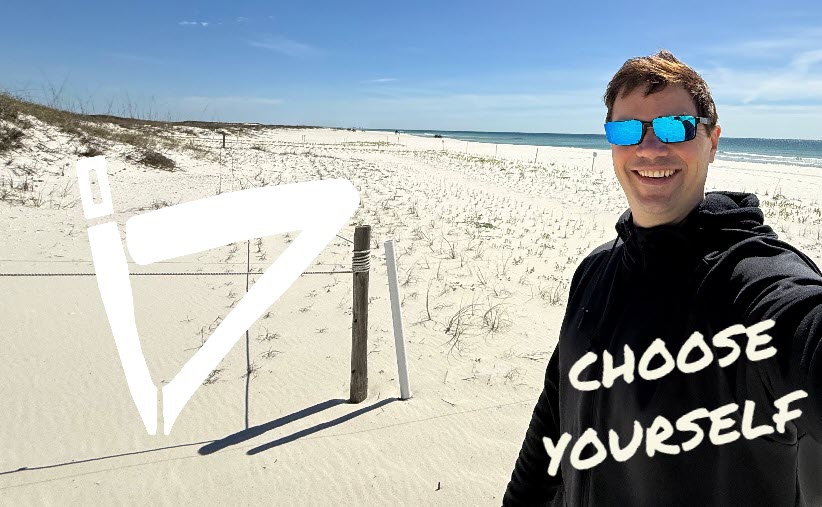
CHOOSE MYSELF …and maybe that is something you need to work on, too.

In this post, I will review a song. This is a song that I heard several years ago while doing yard work. The first time I heard this song, I stopped what I was doing, and I listened to it again. Then I saved it and sent it to myself.

  • I told myself I would blog about it, but then I didn’t write the post.
  • I told myself it didn’t fit my word of the year yet, so I set it aside.

The truth? This song scared me. I felt it too deeply.
I started to feel like I would write this post when I was ready.

Ready for What?

To be ready to choose myself above other people. Something I don’t let myself do. I do not choose myself above other people because:

I am afraid others will perceive me as vain or arrogant.

The Song

Listen here:

Bandcamp: starslingeruk.bandcamp.com/track/choose-yourself
YouTube: https://youtu.be/dmedDwvmTK0?si=JrTypRAxHdr2ADer

I planned to paste the lyrics and react in classic Improvement Dave fashion, but you can read or listen to them yourself. Instead, I’m taking the heart of the song and responding more directly. I’m a creative person—something I once claimed proudly, then quietly traded for stability and responsibility. Therapy has made it impossible to ignore what that trade cost me.

I still need to create to be happy.

I still feel the daily pull to make things, which is why this song hits so hard. I’ve seen firsthand that about 30% of people love my work, 30% hate it, and 30% never notice—so my focus now is on serving the ones who care. And if you are reading this, then that is you.

While the idea of living without purpose sounds dreamy, it feels unrealistic; we all have responsibilities and that ever‑present pressure to do the things we’d rather avoid.

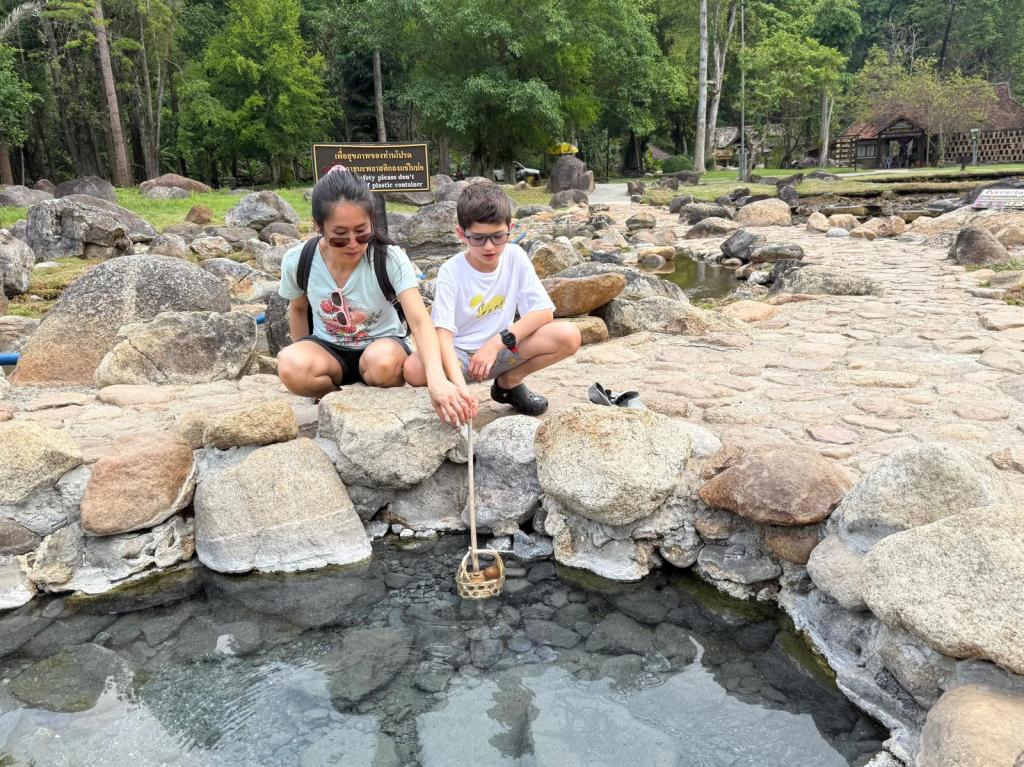
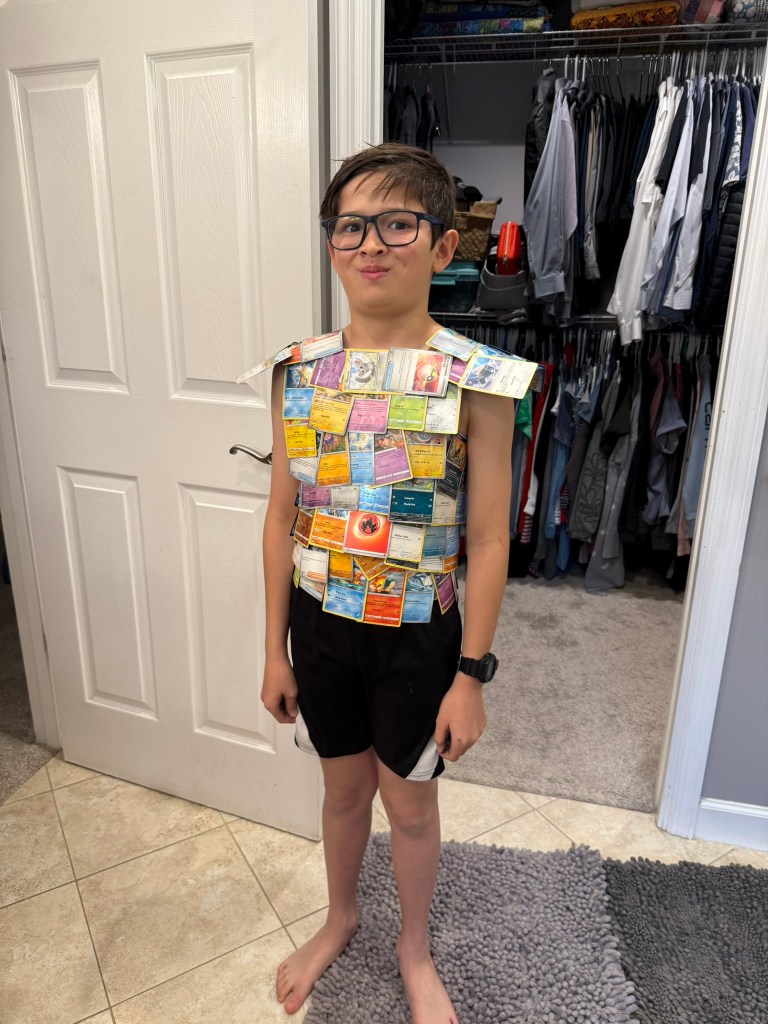
[You can see one of my biggest responsibilities to the right. My need to create has rubbed off on my son. He had a grouping of Pokémon cards he didn’t think were “rare,” so he made a shirt of them.]

I asked if I could post this online, and he said, “Sure, ” without a second thought… I could learn a thing or two from his confidence.

30% or 33.3%?

I still feel the daily pull to make things, which is why this song hits so hard. I’ve seen firsthand that about 30% of people love my work, 30% hate it, and 30% never notice—so my focus now is on serving the ones who care. And while the idea of living without purpose sounds dreamy, it feels unrealistic; we all have responsibilities and that ever‑present pressure to do the things we’d rather avoid.

I traded creativity for stability.

Maybe you’re doing the thing you have to do, not the thing you want to do. I enjoy my career, but some parts hit that familiar knot in my stomach—the fear that comes with admitting I might want something different. It’s like stepping onto a narrow bridge over a pit you’d rather not look into.

WHAT IF

I FAIL?

The answer to this is we never fail. We either hit the nail square on the head or we find a moment of learning. It is a Win (+) or a Delta (Δ).

This quote from the song is liberating to me. It is freeing because I live with analysis paralysis on the daily.

I have lots of ideas, how do I pick the right one?
Execute on as many as possible.
The right idea will pick you.

There’s a theme running through several books I’ve read this year—Big Magic by Elizabeth Gilbert and The Creative Act by Rick Rubin. They suggest that ideas float around in the ether, waiting for someone ready to receive them. Sometimes they show up before we’re prepared; other times we’re ready but unwilling, and the idea moves on to someone who is.

I’ve brought a lot of ideas to life on this blog, but lately I’ve slowed down. I tell myself it’s because of my work on Gamelayer.fm, but that’s just an excuse. I should be using this space to support the podcast, and I haven’t followed through the way I intended.

I can quote the ending of the song out of order for once:


Ultimately, mastery is about connecting the dots of many fields.”


IF we don’t let the mind drift and sit on the side of the road in quiet meditation, observing the thoughts pass. THEN we will never have a creative thought that is ours and ours alone. This is the great paradox of meditation. We are not quieting the mind; we are training the mind.

Master of All Trades

Going back to the song in the order of appearance…

We are:

“…taught at an early age that we are not good enough.

Organized education. School is supposed to prepare us for life, but mostly it just trains us to succeed at school. As Thomas J. Stanley argues in The Millionaire Mind, real success isn’t about grades or pedigree—it’s about the strength of your idea and the grit to make it happen.

Get paid, get laid, lose weight.”

This is that old formula for chasing external validation. But choosing yourself means flipping that script. It’s not about pleasing others or mastering the right test answers; it’s about backing your own ideas and valuing your own voice. Success comes from knowing what you want, standing behind it, and moving with the kind of confidence that makes others follow your lead.

One candle can light a thousand other candles
And still remain lit itself.
Be that candle.

You can earn money from others, but when you offer something real, and they value it, it isn’t taking — it’s exchanging light. That image reminds me of spiritual practice: one candle lighting another, each flame standing on its own.

Lights from the candle lit at night around the church of Buddhist in Thailand
By somchairakin
By somchairakin

The same goes for us. My wife says, “Don’t compare yourself to other people,” and she’s right. Choosing yourself means running your own race, slowing down when you need to, listening to your breath, and taking care of the body and mind you actually live in.

Silence

Mind focused, silence speaks volumes.

Out of silence comes the greatest creativity
Not when we are rushing and panicking.

Choosing yourself means honoring that silence, stepping out of the race that was never yours to run. Don’t trade your health or your mind for money, status, or a title. Golden handcuffs still sink you, and losing yourself is too high a price. When you choose others’ expectations over your own life, you drown long before you notice you’ve gone under.

So here it is

I’m choosing myself. I am making myself write the post,
This post, the one I feared I could never write…

You should, too.

Because…

What do you think? Does this resonate with you?
What is a small change you can make today to start Choosing Yourself?

Work Cited

Altucher, J. (2013). Choose Yourself!: Be Happy, Make Millions, Live the Dream. Choose Yourself Media.

Ellenberg, J. (2014). How not to be wrong: The power of mathematical thinking. Penguin Press.

Stanley, T. J. (2000). The millionaire mind. Andrews McMeel Publishing.

Starslinger (2019). Choose Yourself [Song].

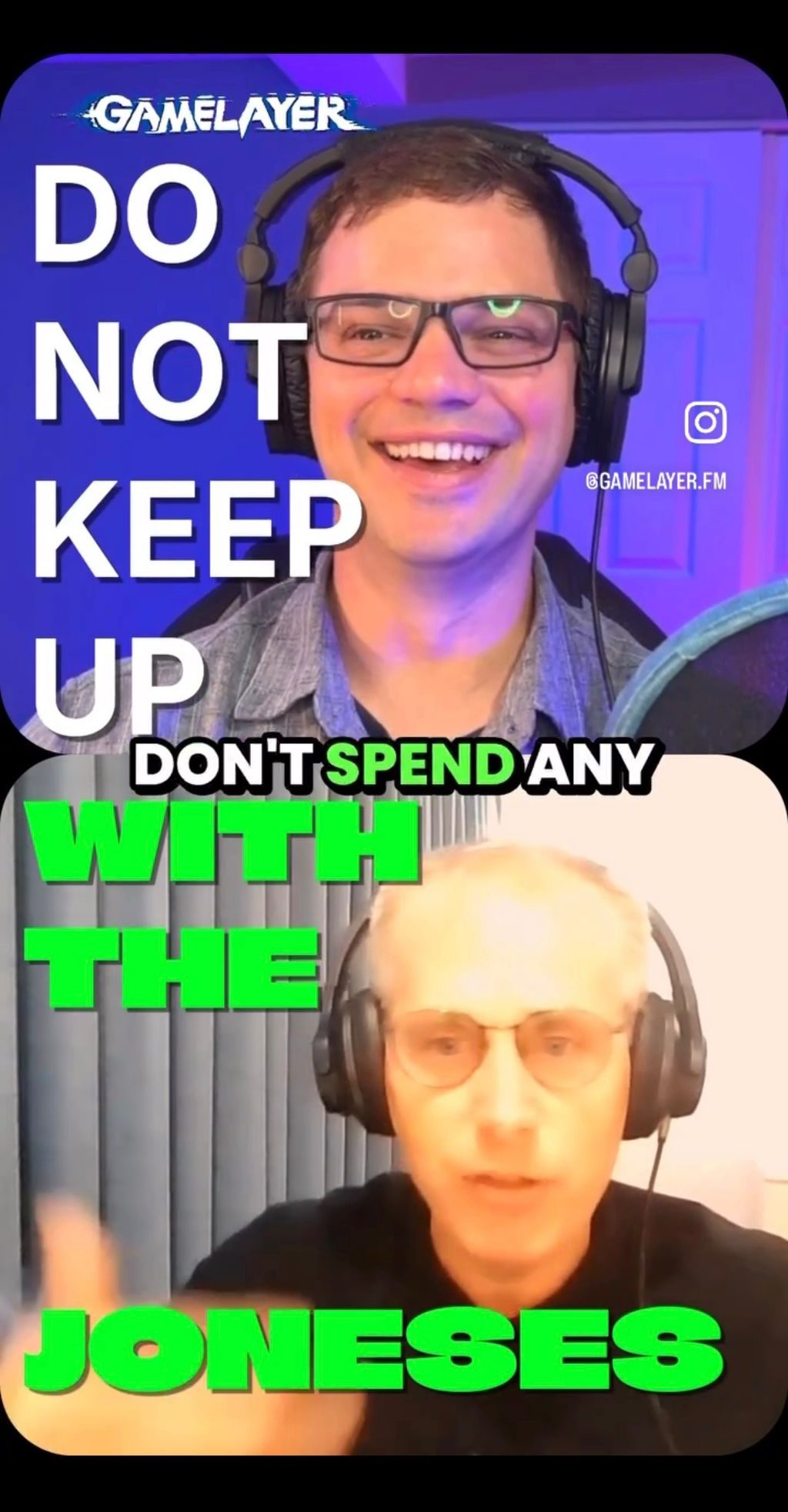
Did you like this article? Then you might LOVE the GAMELAYER Podcast.

Can I Handel the Truth from Chat GPT?

A friend of mine, Lisa, recently made a post where she asked ChatGPT to roast her year.

At first glance, it made me pause. It’s easy to wonder why someone would willingly invite criticism—especially in a professional space like LinkedIn, where we’re often curating a highlight reel of wins, confidence, and forward momentum. Why choose vulnerability when Polish feels safer?

I think about this tension a lot.

On one side, we’re taught—explicitly and implicitly—that confidence is currency. Confidence communicates competence. It signals decisiveness. It reassures others that you know what you’re doing and that you’re someone worth following. In many professional environments, confidence is treated as a prerequisite for leadership.

And yet, there’s a paradox hiding in plain sight.

The most grounded, durable confidence doesn’t come from pretending we’re flawless. It comes from being comfortable with vulnerability.

True confidence allows room for honesty. Vulnerability requires admitting shortcomings—sometimes publicly. That can feel risky, especially when your professional reputation feels like it’s always on display.

But here’s the learning that keeps resurfacing for me:
Confidence and vulnerability are not opposites. They’re partners.

Walking, after all, is just a controlled state of falling. Learning works the same way. Growth is a controlled state of failure.

When we fail safely—with reflection, intention, and humility—we create the conditions for real professional development. We experiment. We stretch. We discover what doesn’t work so we can find what does.

And when some of us choose to do that learning out loud, something powerful happens.

We don’t just grow ourselves—we create permission for others to grow too. We normalize learning. We model courage. We quietly say, You don’t have to have it all figured out to be worthy of progress.

That’s why Lisa’s post stuck with me. And it’s why I decided to do it too.

I asked for the roast.
And yes—I posted it on LinkedIn.

Not because I enjoy discomfort, but because I believe leadership is less about appearing perfect and more about serving others through honesty, learning, and example.

Professional development doesn’t require you to abandon who you are. In fact, the best growth happens when you stay grounded in your values while stretching your capabilities. Here’s a four-step approach I’ve found helpful.

1. Anchor Yourself in Honesty

Growth starts with an accurate view of reality. Be honest with yourself about what’s working and what isn’t. This isn’t self-criticism—it’s self-awareness. Leaders who serve others well begin by telling themselves the truth.

Ask: What am I avoiding because it’s uncomfortable to admit?

2. Choose a Growth Mindset Over Image Management

When protecting your image becomes the goal, learning slows down. A growth mindset shifts the question from “How do I look?” to “What am I learning?” Failure becomes data, not a verdict.

Progress beats polish—every time.

3. Be Brave Enough to Be Vulnerable (Strategically)

Vulnerability doesn’t mean oversharing. It means sharing with purpose. When you talk about struggles in the context of learning, you build trust and credibility. You show others that growth is possible—and ongoing.

Courage isn’t the absence of fear; it’s acting in alignment with your values despite it.

4. Lead Through Service, Not Perfection

Servant leadership is rooted in helping others grow, succeed, and feel seen. When you model learning in public, you remove pressure from others to be flawless. You create psychological safety—and that’s where teams, organizations, and individuals thrive.

Leadership isn’t about standing above others. It’s about creating space for them to rise.

When I created my roast I used the same thread or discussion I used to shape up the Linked In Post I sent to my computer using What’s App. I dictate my writings into my phone while I am making bread or doing dishes or driving. That makes my writing more conversational and fluid. It also makes me more honest.

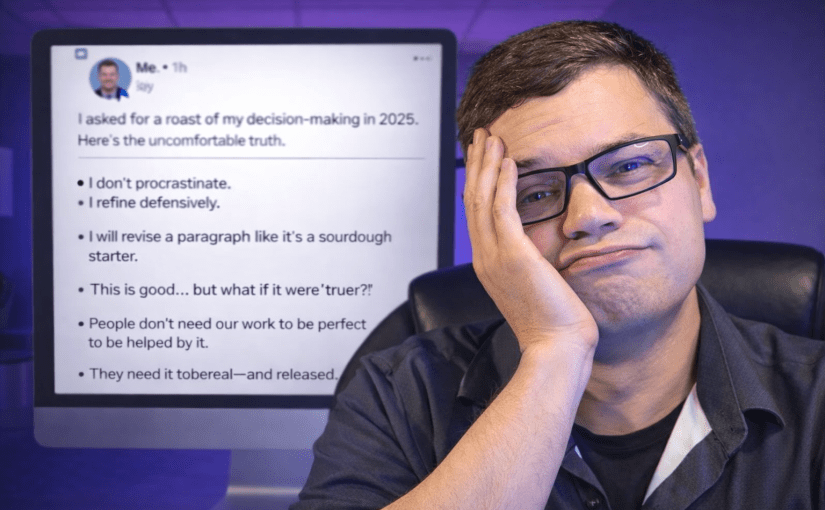
A Gentle Roast of Dave’s Decision-Making & Habits (2025 Edition)

Dave, your biggest decision-making strength is also your most reliable self-sabotage tool.

You don’t just think deeply—you think iteratively. Relentlessly. You revisit ideas like they’re sourdough starters that might finally be ready this time. You ask for version two. Then shorter. Then punchier. Then warmer. Then more UX. Then more servant leadership. Then “work slowly for accuracy.” Then—somehow—more minimal but also richer.

Your brain does not ship products.
It cultivates ecosystems.

You are incredibly clear on values and hilariously indecisive on final forms. You know exactly what kind of leader you want to be, but you’ll rearrange the deck chairs on a single paragraph for 45 minutes because “the tone isn’t quite there yet.”

Your decision-making pattern in 2025 could be summarized as:

“This is good.
But what if it were truer?”

Which is noble.
And also exhausting.


Your Habits, Lovingly Roasted

• You start excellent things more often than you finish good enough things.
• You treat clarity like a moving target instead of a milestone.
• You have strong opinions about colors, frameworks, leadership, and learning—but need external confirmation before declaring something “done.”
• You are deeply allergic to premature confidence, yet secretly wish you could borrow some without losing integrity.
• You believe in learning in public… but still hesitate before hitting “post,” just in case it could be 10% better.

You don’t procrastinate.
You refine defensively.


Your Relationship With Failure

You talk about failure beautifully. Poetically, even.

You believe learning is a controlled state of failure—
but you still want the safety rails bolted on, color-coded, and peer-reviewed before you fall.

You want to be brave and responsible.
Vulnerable and helpful.
Bold and accurate.

Which means sometimes the riskiest thing you do…
is thinking about the risk a little longer.


The Irony (This Is the Roast’s Core)

You already act like the leader you’re trying to become.

You practice servant leadership.
You center reflection.
You value honesty over polish.

But you occasionally delay impact because you want your intent to be unmistakable.

Here’s the hard truth, delivered with respect:

People don’t need your work to be perfect to be helped by it.
They need it to be real—and released.


Final Roast Line (Affectionate, but True)

Dave, you are not stuck because you lack clarity.
You’re stuck because you have too much integrity to rush and too much care to simplify.

Your next level of leadership won’t come from better thinking.
It will come from deciding sooner, trusting your values, and letting the work be slightly unfinished—on purpose.

Which, ironically, is exactly the lesson you’ve been teaching all year.

Sharing our learning edges won’t be comfortable—and it’s not supposed to be. But when done thoughtfully, it becomes an act of service.

So yes, I did the roast.
And I shared it.

Not because I have all the answers—but because I’m committed to the process. To honesty. To growth. To becoming the kind of leader who learns visibly, serves intentionally, and invites others to climb toward higher ground alongside me.

And if that inspires even one person to be a little braver in their own development, then it’s worth it.

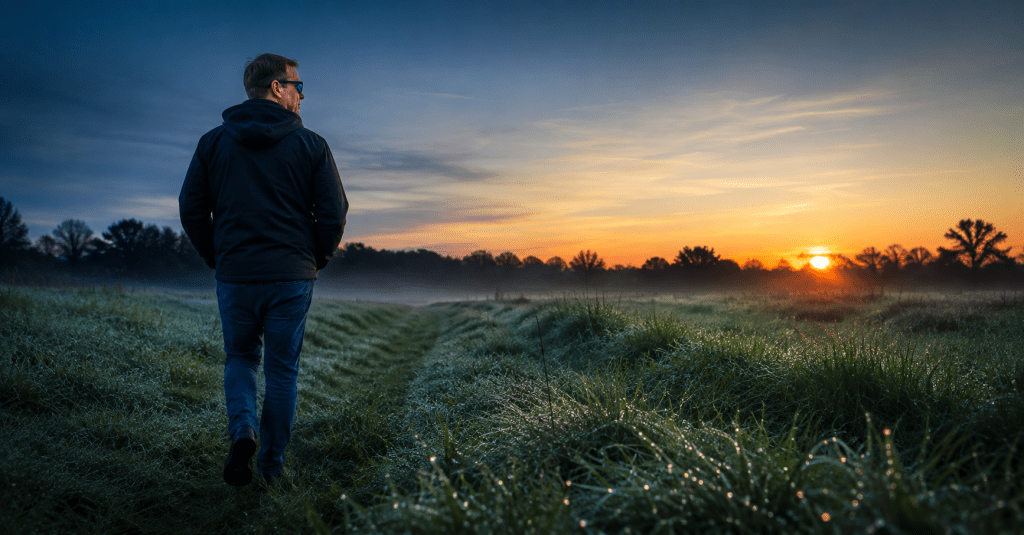
Chat GPT made it…

This is the image I asked CHAT GPT to use to generate the cover image for this post:

It relates to this video…

CASTIN’ PODS – Step 4: Broadcast

Hosting determines where your podcast lives, but broadcasting determines where people listen. All you do is copy the RSS feed link from your host. Then you can paste it into as many podcast aggregation sites as you want, and they will play your show!

Apps like Apple Podcasts, Pocket Casts, or Amazon Music etc. will offer your show on their platform.

In the image above, the data is sent back to Podbean via RSS feed too.

Spotify will host video, but RSS feeds generally distribute audio only. That’s fine—most podcast listeners expect audio.

If you need to edit an episode after publishing, then upload a new version to your host. The new file will replace the old one across platforms.

Well, you can sit back and relax. Focus on finding your next show topic or person to have on your show.

Get it Out There

Now that you have the show, you can also create some buzz around it. Be sure to mention that you have a Podcast so people know about it. The easiest way to do this is to mention it to potential guests on your show.

REELS

When you use Riverside or Descript, they automatically generate 1-minute reels for you. You can download these and share them on Social Media. While you are at it you can start social media pages for your show. It won’t hurt!

Write About Your Show

Another way to get the news out is to write about your show. A simple way to do this is to use the Newsletter function on LinkedIn. If that is not your vibe, then create a blog on WordPress.com or a Newsletter on something like Substack or Ghost. These are good places to paste your show notes and your transcripts. They also provide a vehicle for releasing paid content after you get the show off the ground.

Speaking of sharing your show, I would like to introduce my Podcast. GAMELAYER is a series of personal interviews. I interview a wide variety of professionals who have used Gamification both inside and outside of the learning industry. Season 1 opens asking, “What is Play?” “What are Games and why do we love them?” Season 2 is widening to the Game of the Entrepreneur.

Check it out! www.GAMELAYER.fm

Go build your Podcast!

CASTIN’ PODS – Step 3: Hosting

You want to select the host with the most. Hosting is a very important decision, but for the most part, it’s a backend function.

I had three perks that I was focused on when I was searching for a host:

  1. Free to use
  2. Unlimited storage
  3. IAB certification, (Interactive Advertising Bureau Tech Lab)

IAB certification is useful for having paid advertisements on your show. It is an independent organization that has set standards around play and download data collection.

I wanted unlimited storage, so I looked at Podbean, RedCircle, and Anchor. RedCircle offered free unlimited storage but lacked strong analytics. Podbean was listed as very easy to use, but unlimited storage was a paid feature. Anchor, however, was free, had unlimited storage and robust analytics—but then I found it had been acquired by Spotify.

Host on Spotify. It’s free, has strong analytics, and integrates seamlessly with podcast distribution. (In April of 2024, Spotify left the IAB Certification. There is speculation that they are so big that they don’t “feel they need it.” This has not helped their image.) The analytics at Spotify are great, and some say they are starting their own standard. If Spotify goes away, we have bigger problems than our Podcasts not playing anymore.

How to Host

  1. Go to https://creators.spotify.com/
  2. Set up a free “Creators” account with an email
  3. Enter basic show information
  4. Click the upload file button

People do not know, and they do not care where you host.

Make sure you pick a host that you are happy with. Try to find one you feel you will remain happy with. It is possible to switch, but you will need a backup of your episodes. You will lose the original post date if you ever switch to a new host.

CASTIN’ PODS – Step 2: Edit

Editing video or audio isn’t fun for most people. Unfortunately, it’s also where you’ll spend most of your time if you want a high-quality podcast. Some podcasts skip editing, relying on the value of the conversation or the novelty of the guests. If there is one optional step, this is it, but these days, it really isn’t optional. Now that celebrities are involved, and the word PODCAST has become a common household word, professional editing has become essential.

Most online platforms will record and then allow you to edit on the web. These web-based editors are always limited by nature. Having all of the options that a computer-based editor will have is not practical for bandwidth reasons. That being said, they have enough for a podcast.

Here are some tips and tricks:

  • Use a dog whistle (or another signal) to mark sections that need cutting. The microphone picks it up, even if listeners don’t hear it. (Dogs will hate your show if you don’t take it out in post-production.)
  • Accept silence—don’t feel the need to fill every moment with talking. Keep it natural.
  • Use AI enhancement. Platforms like Riverside.com offer AI-enhanced audio, remove pauses, analyze content, and even suggest edits.

In fact, now that AI is getting better at thinking on its own, it can:

  • Remove dead air automatically with one click.
  • Adjust sensitivity for removing filler words like “um” or “uh.”
  • Generate transcripts
  • Highlight off-topic sections, letting you decide whether to keep or cut them.

Having a prerecorded introduction and outro (Conclusion) to your show is a huge time saver in editing. An additional benefit is the repeated content forms branding around the show. The listener remembers the opener, and it sets the stage and creates a memorable experience.

Once you’re satisfied, Riverside lets you upload directly to Spotify or other platforms. You can also download the files to add branding or for backup purposes. Direct upload is faster. Spotify will take a video file and host it as a video. Then it “broadcasts” the audio to Podcast apps (which is the next step).

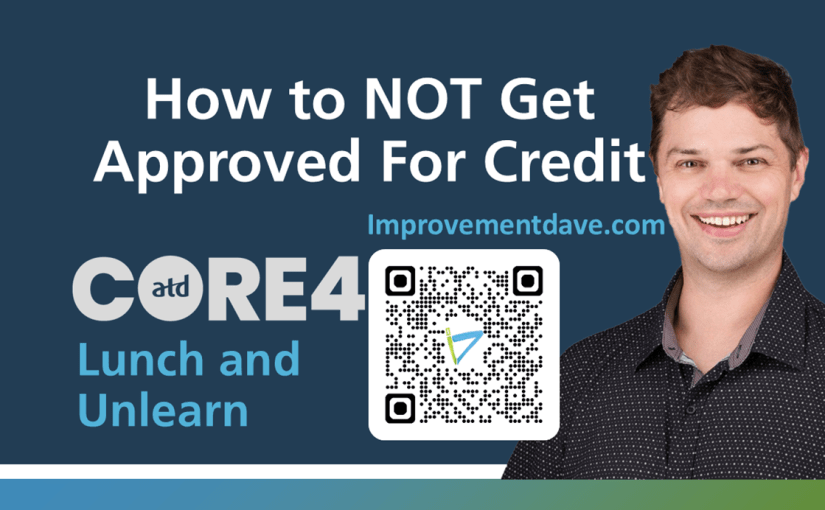
How to NOT get Credit

I was honored to present at the first-ever (and I pray not the last) Lunch and Unlearn at:

I was asked to contribute to an event with ATD CORE4. The Lunch and Unlearn is a simple and UN-SERIOUS take on the traditional Lunch and Learn, and I am honored that Bianca Woods thought of me. I did my best to not take it too seriously. This is my first dry run through to get a time for my part. I went a bit over on time in the prep recordings. I added some timers at the bottom of my PowerPoint slides, and I was right on time at the virtual LUNCH AND UNLEARN event!

To prepare for the sessions, I made recordings of myself presenting. The nice thing about these is that they are over 4 minutes (my allotted time to speak). So, they add more context.

I took this as a challenge to view my presentation in the same way. To not see it as a small thing, even though I only had 4 minutes to present. It reminded me of a learning event that a friend, Kassy LaBorie, shared with me. She had to present her entire brand and purpose on a big stage in front of a live audience. She only got 1 minute to speak. If she could do all that in a minute, surely I can do an “unlearn” session in 4 minutes. I even created a social post around my SPEAK!

I wanted to start with a bit of my background, education, and work history. Then I shared a favorite TED talk for context.

Then I just had to do a mock-up of the old Learning Objective / 3-step process:

How to NOT get Credit

💥APPLY

💥BUY

💥DON’T PAY

To show how Instructional Design and Facilitation is a fluid and iterative process. I want to share the original Dry Run Recording. This was from when I was still developing this program.

GAMELAYER: Behind the Scenes of a New Radio Show 📻

My Unexpected Experience with Riverside.FM

I recently conducted a test recording using Riverside.FM, and it exceeded my expectations. The platform asked dynamic, open-ended questions that really got me talking. Although it was just a demo, I had a blast creating it, and the end result provided a great description of my upcoming radio show, #GAMELAYER.

Initially, I had no plans to publish my first experience with Riverside.FM. However, I was pleasantly surprised by its capabilities. It offered high-definition recordings for multiple participants and provided a range of video editing tools and open-source music. While I couldn’t add transitions to images or videos, I could fade music in and out. Overall, it was impressive for a free platform. As someone who loves using free software (much to the dismay of my computer engineer friends), I was thrilled.

I’ve been working hard on editing the first episode of #GAMELAYER, which features a series of phone tag audio messages sent via text. I’m torn between using the original low-fi recordings to emphasize the casual nature of phone chats or enhancing the audio for a more professional sound. I think I’ll publish the high-quality version as a podcast and host the low-resolution version on the transcript page of my Substack newsletter.

I recently purchased the domain Gamelayer.fm but haven’t successfully linked it to my Substack account. Instead, it redirects to Substack’s main page, which isn’t very useful. I’m considering building a landing page with Parallax animations on Amazon AWS, but I’ve read that the process might be similar to linking to a Substack account, which could be just as challenging. For now, I have some ideas, but they’re still in development.

Currently, my focus is on recording the show. However, I might need to reach out to experts to help launch the webpage. Alternatively, I can let the podcast distribute across platforms via Red Circle for now and work on the webpage after the show’s official launch.

The Ripple Effect of Gratitude: How Thanking Others Can Inspire a Community

I recently made a short simply thanking people who are supporting me and updating the world on what I am working on. I posted it on LinkedIn here.

THANKS all Around today! 🙏 🫂 Thanks to Matthew Pierce 🎦 for sharing the wisdom of just hitting the play button. Thanks to Betty Dannewitz 📻 for getting me on the RADIO SHOW train. Thanks to Paul Smith ♟️ for talking about his “labor of love”, making games.

People who do not follow my blog liked and commented on the post. People in my organization gave it a thumbs up and a heart. My mentor sent me a text and told me the post was very nice. When we give credit where credit is due, and we say thank you to those who have helped us, we build out a network. We build community.

Introducing GAMELAYER: A New Play-Centric Podcast

I am getting warmed up to start a new project. The project is about play. It is a podcast that celebrates all the ways that we play. It focuses on the science of play and the quest of learning. It is about enjoyment, it is about deep learning, and it is about gamified learning environments. I basically stopped recording VLOG videos at some point. I basically stopped writing on this blog to complete the hall bathroom I was updating, and I plan on outlining that process on this blog.

This is A quick recap video that I captured with my updated Podcasting studio and then posted directly to Linked In with Minimal edits. A “fun Project” is what I called the file. I give thanks to the people who are helping me grow and announce my new show, GAMELAYER. I say that it will launch on Halloween of 2025, but it might launch sooner, maybe even as soon as Spring Break 2025. I also share another side project I have started with my dad around building financial independence through Real Estate. This will start as a video podcast that develops into eLearning coursework. MUSIC: ANI KUNI Polo and Pan

I had just got off an introductory call with a guest on the new show I am piecing together and I was fired up. So I decided to record a VLOG post. The radio show is called GAMELAYER.

I have had fun dipping back into my experience as a sound designer. I am feeling the creative process seeping back up like sap from my roots. It is really revving me up and by the end of the day wearing me out!

I have created iterations of the cover art in the web-based design app canva.com and I’d like to share what I had downloaded of those here:
[Click on the arrow on the right to scroll through the design iterations.]

I might just keep recording these short “Fun Project” videos where I dump out all the emotions and the thoughts I am having around putting together a Radio Show. They have been well received. I will keep posting them here as a means of tracking them. I am going to get busy making a Podcast now and I might be shownig less love to my VLOG newsletter here at Improvementdave.com, but I’ll be around.

Thanks for reading, I really appreciate your time and attention. Please reach out to me if you would like to be on my radio show. We all play and we all have a perspective to share. Leave a comment related to how you play. What do you play? Do you play music? Do you play games? Do you play with artmaking? How do you express yourself?

Dave

The Art of Play: Building Bonds Through Simple Adventures

Unless we live in a monastery, we all have busy lives,
and it’s important to find time to do less.

So, just to be clear, I do not work at a monastery, and I have chosen to generate offspring. So for me, it is crucial to build in time for doing less. It’s crucial to build activities into our schedule that don’t really have any purpose other than leisure, fun, relaxation, or recharging our batteries. Last month, I took some time off from work because my daughter wanted to ride the carousel. So I booked time into my schedule to do that, and we entered the game-layer.

We were riding the merry-go-round, but let me back up. I picked her up from school, and we were driving to the park that had a historic merry-go-round. I needed to stop and get gas. At the time, I had already started recording for this podcast. I was playing an audio text message game of chess with my friend Sarah. She had expressed anxiety about being on a podcast show, and when I asked her to record a message that says “play chess,” she ended up sending me a three-minute recording about how she was doing that day and slowly phased in the statement I was seeking. Naturally, I just texted her back, thanked her, and then created my own audio message, thus beginning our chess game podcast via text message audio recording.

As I was driving to get gas, I got out of the car and recorded a message back to Sarah. Then I went in with my daughter and bought her an ICEE, which is a very special treat in our world. I sent the audio message, not knowing that in two days my new iPhone would automatically delete it. We went to Faust Park, and I purchased three tickets each to ride the carousel repeatedly. I made videos of the carousel, and later my daughter commented on how we weren’t in the videos. I created videos about the firsthand experience because I was in the game layer; I was focused on the process and the environment more than the faces of the people around me.

What struck me the most about the experience of riding the carousel with my daughter was obviously the emotion on her face, but that was for my soul. I didn’t want a record of that to be posted on my blog or captured in my podcast. I did take a lot of pictures of her, and there is some video of her riding the carousel, but I’m not going to share that footage here, and that’s intentional.

The reason this moment struck me to my core is because I was creating time for fun. I was planning play into my schedule. What struck me the most about the experience was mostly the sound.

There was the canned music in the beginning, which was overpowered by the mechanical sounds of the ancient carousel lumbering across its hub. The second round on the carousel also had canned music, but it was a different song—maybe a better song. But the third round was the best. The operator fired up the old Orchestrion, a mechanical instrument slightly bigger than a piano that can synthesize an entire orchestra with reels, xylophone, real drums, real chimes, and even real trumpets.

(Now I wanted to call that a glockenspiel which does seem like a better name, but apparently a glockenspiel is just a xylophone with metal bars.)

This is the experience that I had come for—not spinning around on an old, ancient wooden horse—although I did enjoy that significantly. It was the machine—the small machine that didn’t dish out a synthesized audio recording from a hard drive. It played; it had analog motors with sticks that struck objects. It was a physical representation of the GAMELAYER.

After we got off the merry-go-round, my daughter and I were outside walking back to the van in the rain. I noticed a different energy about her. She was commenting nonchalantly about the pavement and the grass. And she turned around and looked at the building that contained the massive artifact of play. She said something that, to a six-year-old, is a comedic masterpiece: something about those people getting to live in there—that must be so fun! I agreed with her even though I knew I wasn’t understanding that statement on the level she was.

My daughter turned and told me that she loved me, and I told her I loved her too, because I do. She asked me to carry her, which is basically her way of asking for a hug. So I carried her through the rain back to the van, and we spoke openly and freely, and our hearts connected through our words. And in the tone of her voice, I could tell that I had made a difference. I had put her needs ahead of my needs; in that way, we became better friends—we became closer. I built trust with her; I made time for her, I created empty space so that she could play.

Oh, and the audio recordings that my phone deleted? I think Sarah has those—or at least she said she does! We’ll see if she makes the choice to share them back with me so that I can add them into our audio-chat-message cat phone tag game of chess radio show episode of GAMELAYER.

I would like to personally thank Perplexity.ai for helping me shape this up for readability without changing my message, writing style, nor tone.