

RIVERSIDE.AI – on July 22nd 2026, there was a broadcast recording of a discussion between a one Eleanor Ross, [Globally Celebrated War-Game Expert, avocado record-breaking up-seller, Middle-East linguist], and a one David Kolmer [Radio curator, Lemon Drinker, and Learning Artifact Craftor] The two discussed the complete trajectory of human experience, including various fermented vegetables, citrus-based breakfast beverages/baked goods, and the philosophical underpinnings of international diplomacy.
The conversation opened with cordial inquiries into the current state of affairs, specifically regarding Eleanor Ross’s state-of-the-art lime situation. According to sources present at the broadcast, Ms. Ross had acquired “forty limes” — a figure she emphasized she was “not exaggerating” — following an overambitious Fourth of July key lime pie initiative approximately three weeks prior.
“I squeezed all of them while watching Jeopardy,” Ms. Ross reported to Mr. Kolmer, who appeared to take the statement seriously and without judgment.
The limes were subsequently transformed into a lime loaf cake, which Ms. Ross paired with scrambled eggs for dinner the previous evening. When asked about the cake by an apparently foodie-enthusiast Mr. Kolmer, she confirmed she would be consuming additional servings as part of her lunch routine.
Mr. Kolmer, for his part, disclosed that he had consumed a Thai omelette that morning, featuring “cut up broccoli and carrots and Thai basil of all things,” cultivated in his Missouri residence. He noted that while Thai basil is technically a perennial in Thailand, it becomes merely an annual in the continental United States, though seeds do occasionally persist with what he termed “just keeps happening” frequency.
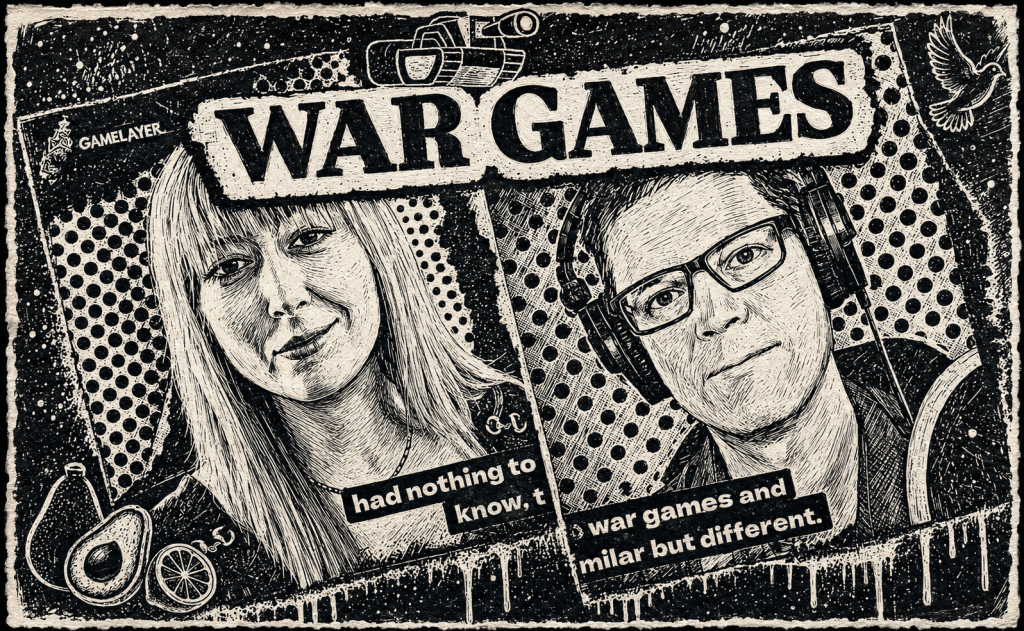
FASTING, PHILOSOPHY, AND CITRUS LIQUIDATION
The conversation then pivoted to Mr. Kolmer’s personal relationship with intermittent fasting, a regimen he has pursued with the intensity of a man determined to squeeze lemons into a blender.
“I got into fasting for a while, intermittent fasting,” Mr. Kolmer explained. “What I did with the lemons, I know that sounds kinda scary, but I’ll drop a whole lemon in the blender with some stevia, like the sweetener, and just blend that up and drink it.”
Ms. Ross countered this assertion with what sources identified as “impeccable logic,” noting that “we all interminute fast. It’s called sleep.”
The two appeared to reach consensus on this matter. Still, Kolmer was processing in the back mind of his lizard brain that Autophagy (Greek for self-eating comes from two Greek words: autos (meaning “self”) and phagein (meaning “to eat”). Translated literally, it means “self-eating” or “self-devouring”. [1, 2, ]) really doesn’t start until at least 16 hours into the fast. Hence, he keeps his fasts to around 20 hours or up to 48 long once a month.
Kolmer declined to verbalize this opinion at the time of recording, but later was cited by those on the scene as saying, “I didn’t really want to mess up the vibe and flow of the convo Yo Ya’know? I just wanted to roll wit dat shit, but really I wanted to share my pseudo-science opinion on autophagy that has only been proven in lab rats.” Kolmer also added a 1-minute aside in post-production on the topic that, in retrospect, he felt did not make a solid scientific claim on his position, and he fears may cast him into the endless pit of being perceived as believing pseudo-science and as he put it “Cruncheeyee Gronala @$$ woo-woo bull-sh!t”.
FROM SANDWICH RETAIL TO GEOPOLITICAL SIMULATION
The broadcast subsequently traced Ms. Ross’s remarkable career arc, beginning in Charleston, South Carolina, where she grew up “surrounded by good Southern food” and politically engaged family members. Her civic involvement continued through her work as an absentee ballot clerk during the 2020 election, a position she maintained for the entire summer after “hang[ing] around” past her shift’s conclusion.
Before becoming recognized as an authority on war gaming, Ms. Ross held several positions in customer-facing service, including front-of-house responsibilities at Co-op Gourmet Sandwiches at age fifteen. During this period, she established what may be an unbreakable record: “I won the person who upsold the most avocado when I was like fifteen,” she stated with apparent finality.

The Citrus of Whimsy and Belief, The Crescent Moon and Dharma Wheel of Faith.
When pressed for details, Ms. Ross revealed that the avocados in question were offered as sandwich additions, and that her sales prowess earned her “like a hundred-dollar bonus.” Mr. Kolmer assured her that this figure was indeed “a lot” when one is merely fifteen years old.
Additional professional experience included employment at a bed and breakfast in France and a hostel in Morocco, where she served both as a yoga teacher and breakfast server, thereby establishing a pattern of multifaceted employment that would become her trademark.
THE ARCHITECTURE OF MANUFACTURED CONFLICT
The discussion then escalated into more sophisticated territory. Ms. Ross is a war game designer, a professional who manufactures complex simulations in which participants navigate geopolitical crises that may or may not include realistic-looking social media.
These games, she explained, typically involve written materials, injected breaking news, and role-player interactions. Participants submit “moves” that alter the simulated world, creating what Ms. Ross described as “zero-turn gameplay where it’s continuous” or turn-based alternatives with “short breaks for adjudication” and “expert discussions.”
The creation of these fake social media artifacts serves what Peter Perla — identified as “one of the grandfathers of war gaming” — would approve of: the creation of the alternate reality in the magic circle of the game. Or as Mr. Kolmer, apparently comfortable cross-disciplining, noted: “In theater we call that the suspension of disbelief.”
“Making media look real, that’s the way you can do it,” Ms. Ross affirmed.
INFRASTRUCTURE, FAILURES, AND THE RETURN TO PAPER
Despite the sophisticated technological apparatus supporting these simulations, Ms. Ross reported that things sometimes break. During one of their games, a third-party platform failed entirely. The response was swift: the entire operation pivoted to email, with materials printed and distributed by hand.
“You need to be able to adapt, right?” Ms. Ross explained, suggesting that knowledge of “the old ways too” remains strategically valuable in the twenty-first century.

THE PHILOSOPHY OF HUMANIZATION THROUGH SIMULATED CONFLICT
In her closing remarks, Ms. Ross articulated what appeared to be the ultimate purpose of her work: “Games show other people that people do have the bestest of intentions.”
Well-designed games, she suggested, push participants to recognize that their opponents are “working towards what they think their best interests are,” thereby creating opportunities for humanization. “The humanization of the other and even defining them as the other in the first place” — these are matters currently undervalued in contemporary discourse, according to her assessment.
Mr. Kolmer appeared moved by this statement, noting that “it feels like your closer is gonna work really well as your opener.”
SIGN-OFF
As the broadcast concluded, Ms. Ross extended an invitation for audience members to contact her through her Expert Theory website or via LinkedIn, where she promises to respond to messages “within the week.” Mr. Kolmer expressed hope that he might someday participate in one of her games, a request to which Ms. Ross agreed enthusiastically.
The broadcast ended with expressions of mutual professional appreciation, leaving open the possibility that Mr. Kolmer may one day engage in a simulated international crisis while remembering the tactical advantages of the analog world and the personal integrity of his opponent. 🥑🍞
EDITOR’S NOTE
Editor’s note: Sources confirm that neither Eleanor Ross nor David Kolmer were harmed in the production of this broadcast, and that all lime-related statistics have been independently verified. However, the avocado upselling award of $100 was not confirmed but fact-checkers argued in a fully-staffed team-meeting:
“WHO THE DUCK WOULD LIE ABOUT THAT SHEET, MAING??”


S3E02 Part 2 | The Art of the Circuit⚡The Art and Creativity of Electrical Work | Mark Borreggine – GameLayer Radio
- S3E02 Part 2 | The Art of the Circuit⚡The Art and Creativity of Electrical Work | Mark Borreggine
- S3E01 Part 1 The Art of the Circuit⚡From Warehouse Work to Electrical Engineering | Mark Borreggine
- 220 Is this the END for the INSTRUCTIONAL DESIGNER? | Jamie Thomson
- 219 When Passion Becomes Work | Kerris Garbutt
- 216 Becoming Instead of Reacting [PART 2] | Christopher Federer

