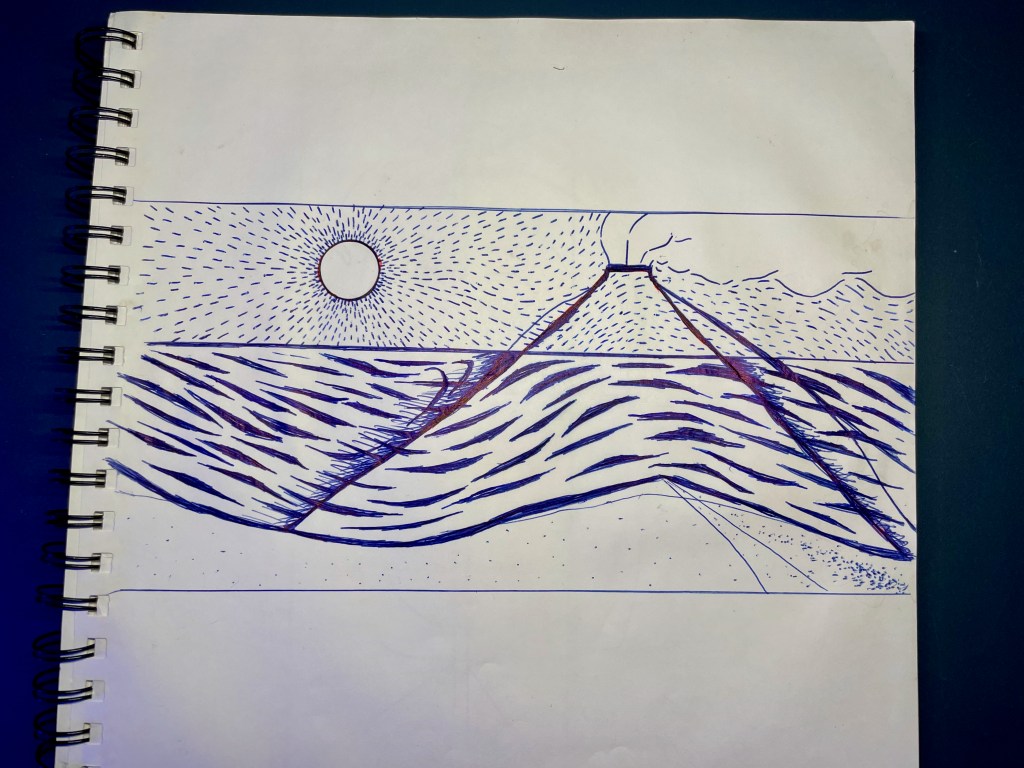
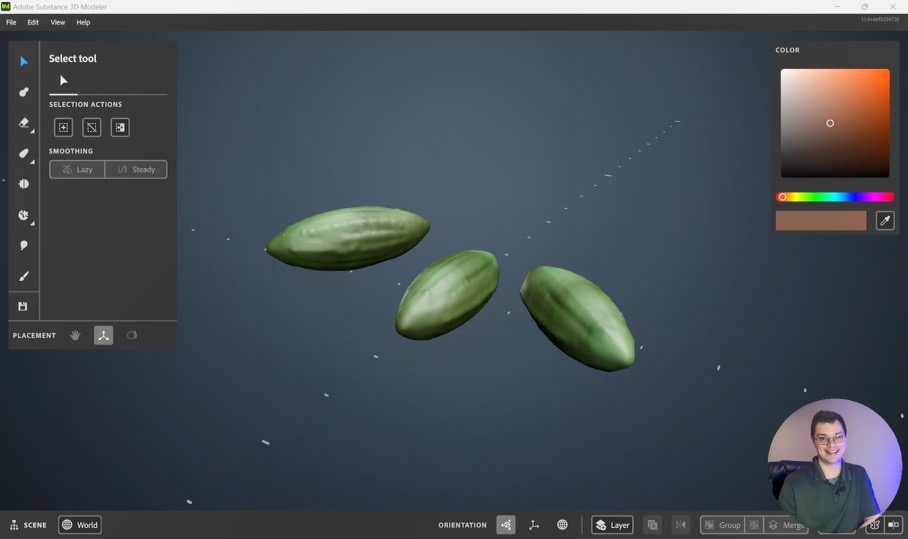
Welcome to Day 6 of my 30-day 3D Design Challenge. I watched instructional video #7 in the list last night so that my subconscious mind could start generating ideas for today. What I decided is that the video quickly begins adding steps under the topic of Symmetry and Repetition. When the video jumped to adding symmetry and repetition at the layer level and then upped it to the global layer level just to switch over to the group level I had a feeling that “…this is something I understand right now but someday soon I will be working on a project and get stuck or confused about what I am controlling“. In other words, I felt a bit like I was peering into the 5th dimension for the first time. Maybe, this has to do with how the content was designed or how the video was created but it probably has more to do with my lack of experience with 3D design. So, I have decided to break this topic into two parts. I will cover
Day 6 – Part 1 – Symmetry and Repetition on the layer level and on Day 06
Day 7 – Part 2 – Symmetry and Repetition on the group level on Day 07
Part 1 – Symmetry and Repetition on the layer level
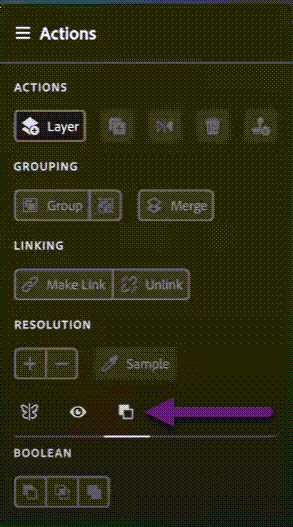
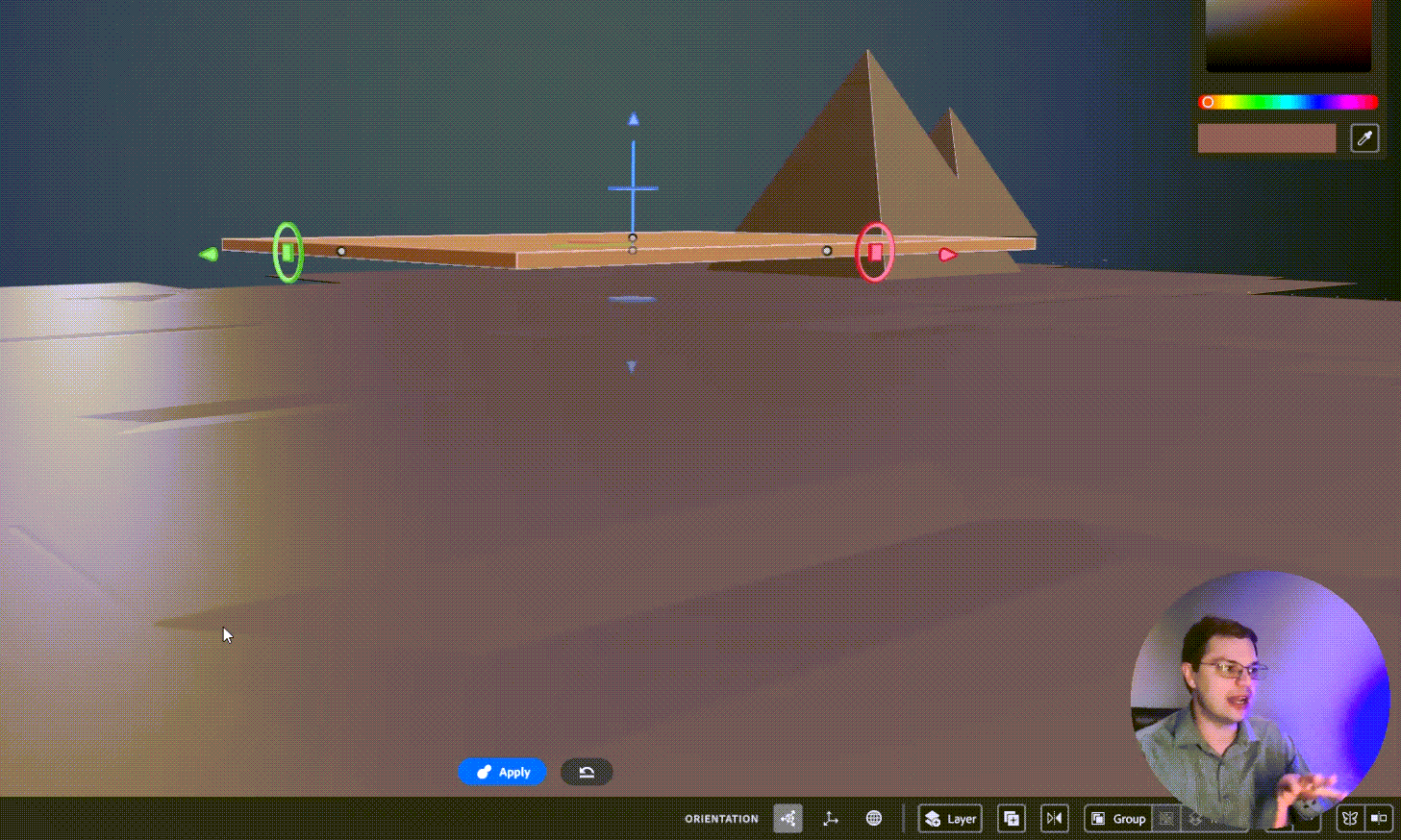
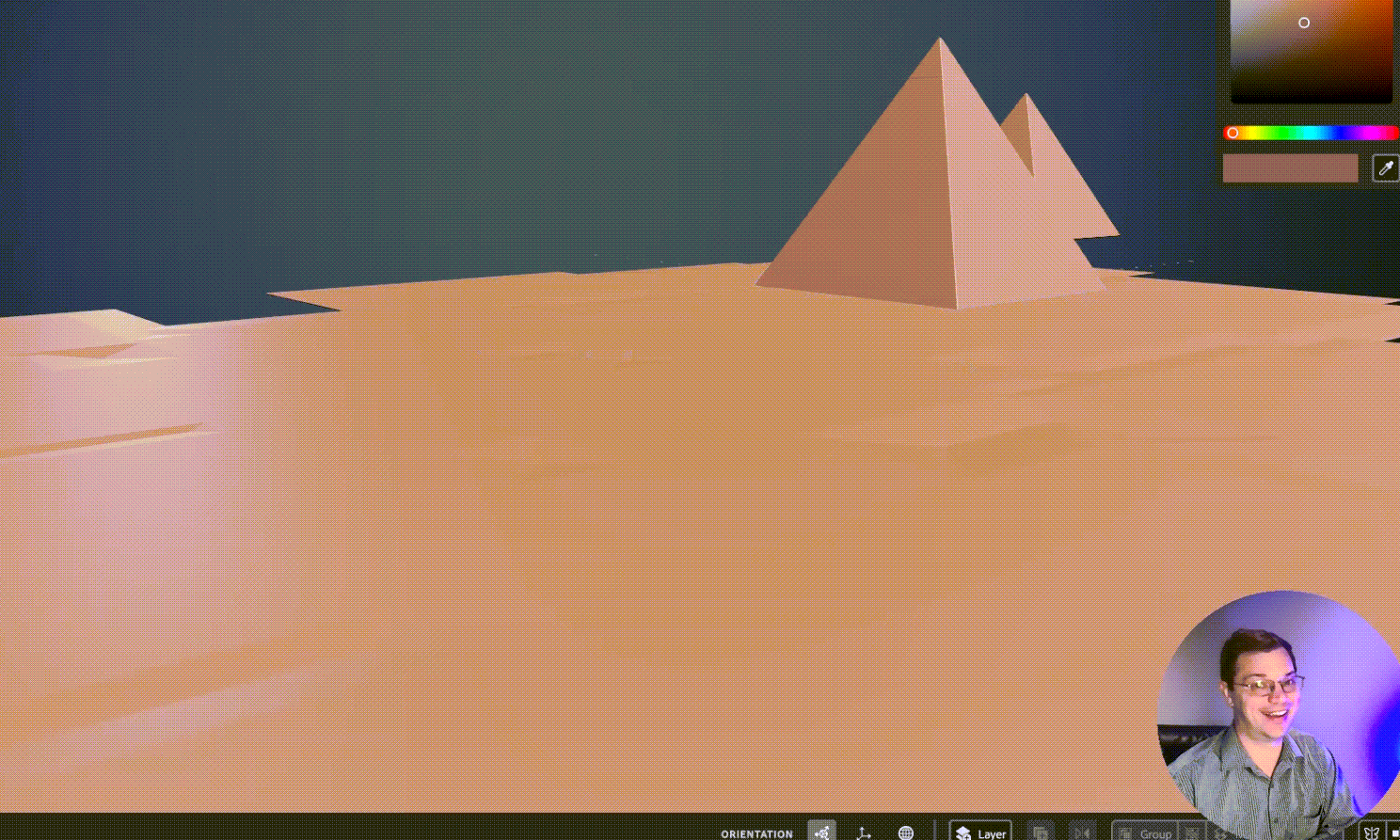
When the video starts the instructor explains where symmetry can be found at the bottom right of the screen and in the Actions menu when you right-click. What is interesting is that symmetry is set per layer but then it can also affect your design globally, at the scene level with nothing selected. I think this second part is why adding the group symmetry concept with this same video was just too much for me in a single lesson, but again I am a NOOB with this 3D design stuff, so I want to be very clear about that. It’s not the Adobe instructor, it’s me. I have kept the demonstration today in the 3 separate raw videos.
Video 1
Video 2
Video 3
Thanks so much for watching! Learning is not easy so thanks for the support!
Tools
Symmetry
Radial Symmetry
Repetition
Radial Repetition
David Kolmer
I generated this content after watching this amazing instructional video by Adobe:
The stamps live next to the primitives as a shape option for the clay tool and the erase tool.
Stamps can be in any shape! Also, Adobe Modeler comes with preinstalled stamps!
Check out what I came up with in the video, stay tuned below for more detailed step-by-step information on how stamps work.
Video of my creating
What are Stamps?
Stamps are based on meshes rather than the math of the primitives (essential tools for clay building) The outcome is that there are fewer options to change the Dynamics of the shape (like Taper, Fillet, Round, etc.) You can see above that Size is the only option to change the Dynamics of the stamp tool selected. Although, Single, pressure, and steady are still options which is a great thing.
There are two ways to make Stamps
First Way to Make a Stamp
You can make a stamp from a layer.
Select the layer
Right-mouse click to open the Actions menu.
Select the Stamp Icon
I want to point out that if you are working in VR the stamps in the tray are previewed in 3D. I just think that is amazing.
You can click on the create stamp icon anytime you are editing, because when you are editing you have a layer selected.
Second Way to Make a Stamp
You can import stamps as mesh files inside the app.
Modeler currently supports importing stamp meshes files in these formats:
OBJ
FBX
USD
GLTF
IMPORTANT: These files must be added through the app, you can not just dump them into the Window where MOdeler stores stamps. (Adobe > Adobe Substance 3D Modeler > Stamps)
Day 4 of my 3D Modeling 30-Day Challenge I have been wondering if Adobe 3D Modeler should be used for creating organic outdoor landscapes. It makes sense that this sort of scene would come up in the topic of “Resolution” because this file became very large very quickly.
In the video, I say that “I noticed resolution but it didn’t really click on what that was.” So, for the record: I know what resolution is and I should have brought more of my Adobe Photoshop knowledge to the table. What I meant to say was that it didn’t click how relevant or significant the resolution would be to file size. Then add to that the ramifications of delay to process certain morphs, smoothing, or the simple act of saving or opening the file.
I timed opening the file at 17 seconds but I noticed I missed 2 seconds in the beginning so it was probably an actual 15. Then I lowered the resolution, saved, and timed reopening the file. I lowered the resolution so low that the ground was actually damaged and had holes in it. So, too far! but the open time went down to 4 seconds with an actual of probably 1 or 2 seconds. So definitely improved the file-open time with a lower resolution.
Day 04 Resolution – 3D Model 30-Day ChallengeDavid Kolmer is an Instructional Designer and facilitator who does not know how to design in 3D. His goal in this rough cut series is to change that and be able to make a logo in 3D for his brand.
I returned to the room I designed yesterday on day 2. I didn’t particularly appreciate how the couch cushion was fused to the couch’s body on a single layer. I went in and deleted the cushion and then switched over to the clay tool to add a new one on a new layer. This is shown in this video.
Day 03 (Day 2 review) 3D Model 30-Day Challenge Assembly Review
I was really chatty in this demonstration. I think it was because it was right after my first cup of coffee right before work! I was psyched!
Day 3 – More Tools!
I really enjoyed the 4th video on Substance 3D Modeler from the curated playlist tutorial series by Adobe. ( First Steps with Substance 3D Modeler – 04 All Tools) It covered the rest of the tools and showed other ways to use the first tools covered in the series. Remaining sculpting tools: Buildup, crease, Inflate and paint.
⭐ Buildup Tool
“B” key on the keyboard.
This tool is used to build up areas on the clay.
⭐ Crease Tool
Subtool to the buildup tool.
pull up and pinch a ridge on the clay’s surface.
Tab will alternate pinching up and creasing in.
⭐ Inflate Tool
Continually inflate the clay surface where the tool comes in contact with the clay.
You Change the intensity and also select deflate mode.
⭐ Paint Tool
Can be used as is with the color selection panel,
Also works with all the shapes found under the clay tool!
Nothing fancy but a good way to give an object a decent shaded texture good for a base coat.
Check out what I came up with from using the rest of the tools!
Day 03 – More Tools – 3D Model 30 Day ChallengeLook I made some seed pods in the 3D metaverse!
I rebuilt the basic shapes from those tutorials as a review of day 1.
I am having an issue with zooming in on a single object and getting too close. Then when I zoom away the work that I have created is out of view. I try to tap the “R” key twice like it said in the first tutorial but it doesn’t always seem to reset the scene. The workaround I have found for now is to save and reopen the project. I show this at the end of the video below.
Image of my workspace where I can’t seem to focus back on the object I’m creating
While trying to solve this problem I saw this fantastic page that shows all the key commands used for Adobe Substance 3D Modeler, which is super helpful. Thanks, Adobe! You rock!
At lunch today I viewed tutorial Video #3 from the free Adobe Tutorials on at least Adober Substance Modeler. I say in the video that I picked a scene of a room from a house because of my theater, instructional design, or house rehab background; but it is just as likely that I have been learning Multi-Craft (later iteration of Minecraft) with my son. I also made an attempt to improve the lighting in my room for this recording. Here is what I came up with from day 2:
I am going to teach myself how to create 3D objects in the virtual space. I don’t know how to use Adobe Substance Modeler, Adobe Substance Painter, or Adobe Substance Designer, nor do I know how to use Adobe Substance Stager. I am going to spend the next 30 days taking the free Adobe Tutorials on at least Adober Substance Modeler and sharing my experience here. We will see how it goes!
Upon taking some preliminary video courses I have learned that this can lead to designing in Virtual Reality and Augmented reality and I want to be very clear that, this is my ultimate goal. For now, I want to build a logo for my brand and I am thinking that the 3D space might be easier than Illustrator. I have some basic designs in Illustrator and they look well… flat.
So far I have been working in Adobe Illustrator which to be fair I have not used in over a decade. I like it, it is very powerful. HUGE shout out to my buddy Luke Lindberg who has been holding my hand through this process. You are the man Luke. If you need a graphic designer, then hit him up!
What I love about living in 2023 is that if you want to learn something new chances are the platform that makes the product you want to learn is producing high-quality learning content and sharing it on Youtube for free! HOT JAMS! Just look at this, 10 fresh clean learning artifacts that walk me through the process. I would be mad to not take advantage of this! Adobe Tutorials “https://youtube.com/playlist?list=PLB0wXHrWAmCwrvuebNKHc7rooXkkVDwln“
So, I am jumping in, I am teaching myself something I know nothing about. So let’s look at what I came up with. You can tell by the concerned look on my face in the next video! This is not the face of a man who knows what he is doing. This is the face of a man who is vulnerable and swimming in waters he does not know.
After Working with the First 3D Substance Modeler Tutorial #1
So, to be candid. I created something and it didn’t work because I was just messing around with the shape of the brush and not actually creating something. Then when I went to reopen the file there was nothing there because I didn’t create anything. So I actually created this after watching the second tutorial but it relates to the first tutorial so I will share it first.
After Working with the First 3D Substance Modeler Tutorial #2
In this tutorial, it became clear how to use the creation “gizmo” or “brush”. You can press the “e” key to set it to a transparent object for erasing. Or you can press the “c” key to create in clay. I am still not clear on what pressing the “c” key does. It sort of bakes the clay and then you can’t erase what you have already done. I really dug in here and created many layers to get an idea of what the limits were.
I am really excited to enter this new space. Even if these aren’t the tools I eventually need to create VR and AR experiences learning these skills will be valuable when I do. I would like to thank the learning team at Adobe who put these learning playlists together. YouTube really is the best LMS on the planet Earth.
Gamification became a hot topic, then a buzzword, and then LMS systems started adding badges for completing painful eLearning modules and calling it gamification. Now those not in Learning & Development see “Gamification” as a worthless fad because they don’t know what it is. Let me attempt to explain game-enriched learning environments.
As I was at my local gym, I found a PRECOR elliptical machine that let me log in and create a user name. I was hoping that this would allow me to track my usage on my phone and therefore onto the YMCA app where I track all of my exercises, but I am not that far in my Metaverse journey to awesomeness.
But now that I’m logged into this elliptical machine, it started to throw badges up on the screen when I hit certain landmarks over my entire elliptical journey.
You just walked across the Golden Gate Bridge! Your cumulative distance over time is the same as Taking a train from Beijing to the Great Wall of China!
NICE! Thanks, PRECOR! That makes me feel really good right now. I am motivated to exercise so these badges alone increase my motivation because I want to see what the next badge is. However, this on its own cannot be considered a game.
If these badges were used for unmotivated learners, then they would simply become asinine and probably, decrease motivation.
Often when I speak to experts, who are skilled and experienced in adding games to learning experiences, they tend to not like the word Gamification. It’s a dirty word now. Why is that? A lot of business leaders and learning stakeholders have requested Gamification in ways that don’t serve the learning model. Gamification is implemented without the funding or skill sets required to deliver.
For example, learning management systems have added only badges across-the-board, and called that gamification. Not even a leaderboard of who is ahead, just little images with arbitrary words like “HOT SHOT” and “ACE”. That’s not a game that is a reward that you could’ve won if you played a good game well to add merit to your performance. However, getting that badge after taking a raw DATA-DUMP in a trackable SCORM eLearning is more like a kick where the sun doth not shine than a game.
So, it has to be a good game and it has to build skills.
I like to think about games with learning purposes on a sort of quadrant.
First of all, is the game fun, or is the game not fun?
Second of all, does the game build skills are does the game not build skills?
( Skills here are skills that can be used in the real world. I would say Educational but that would be a circular definition and possibly a slippery slope that is not accurate. I have also hesitated in using the word Educational here because I don’t want to trigger memories of your teacher or mother asking if the show is “educational” or not? and now I probably triggered it anyway, which is good.)
Quadrant: Fun/not fun develops skills/ develops no skills
What are things that you can add to the games that make them great?
How do you make “FUN” games?
The game mechanics are the solution. (be sure to scroll down to the end to see videos of my favorite game.)
Game Elements
Believe it or not, there is a whole field around how to build games, and we are not just talking about video games here either. These ideas and tools work on all games from monitor and VR to paper and cardboard.
If you want to talk about building Gamified Learning Environments then you don’t have to look much further than the work of Karl M. Kapp. His book “The Gamification of Learning and Instruction” is basically THE BOOK.
Why are some games a one-and-done and others are repeatable? It has to do with the elements of the game, the interrelationship of the elements is what makes the game engaging. Games are based on models of reality known as operating models.
The benefits of abstracted reality:
Easy to understand complex concepts
Cause and effect are obvious
Removes extraneous factors which pose distractions
Reduces the time needed to grasp the concept
Goals
Game goals differ from instructional Goals. Game goals are specific and quantifiable. Instructional goals are broad and general. The final goal should not come too early. Ideally, there are sets of goals that build skill sets that are used to complete the final goal.
Operational Rules: Need the right key to open the right door
Constitutive Rules of Foundational rules: these are usually most important to the game designer. Probability of a die hitting a 6 or card counting
Implicit rules or behavioral rules: Govern the social construct between players. Usually tied to a penalty if broken.
Instructional rules: Define gameplay. The player must internalize before gameplay
Conflict, Competition, or Cooperation
Conflict is a challenge from a meaningful opponent and focuses on slowing the opponent down.
Competition is when a player is “constrained from impeding each other and instead devote the entirety of their attention to optimizing their own performance”.
Cooperation is working with other players to achieve a desirable outcome.
Time
Time is often used as a motivator to take action. When the clock starts. Time is also a part of helping learners allocate time to pieces of their work. The benefit of games is that they can condense time to view actions and results in real time.
Reward Structures
Badges, points, and rewards are not all bad and it is equally fun to let someone else know you received them. The leaderboard is a prime example of a reward where the user sees how they match up against all other players. It motivates additional play. It is best if rewards are directly linked to difficult accomplishments in the game. The text claims that LMS systems do not have corporate leaderboards but that might be dated information?
Feedback
Feedback is more frequent in games than in traditional learning environments. Robin Hunicke describes engaging feedback as juicy. Juicy feedback is tactile, inviting, repeatable, coherent, continuous, emergent, balanced, and fresh.
Levels
There are three types of levels: Game level, Playing level, and Player level.
The Game Level is useful for plot and storytelling. Skills can be built at each level. The level-up is a motivation to continue.
The Playing Level. A simple game is boring and an overly complex game is not fun. Therefore many games have an entry-level at the beginning, easy, moderate, and difficult. It is often helpful to have the first level as a demonstration with guidance and feedback on how to play.
APlayer Level relates to the character’s experience level or experience points in role-playing games. So, think Final Fantasy or Pokemon where a player has EP or “Experience Points”.
Storytelling
Storytelling can be as simple as the name of the game. It can be supported with minimal additions to create a plot. Today video games have huge storylines and back plots. Stories add meaning, provide context, and guide action.
The Hero’s Journey
The monomyth or the hero’s journey includes leaving the comfort of normal life and entering the unknown to battle the conflict. Stories like The Legend of Zelda and even Super Mario Bros build on the Hero’s Journey.
Curve of interest
Using “The hook” to move from this being a required training or an interesting topic toward the learner being excited about the learning experience. The entry point, is that it is mandatory learning, then the Hook where the learner’s attention is grabbed. Last is the climax and then the learning is over.
Aesthetics
Aesthetics range from the design of game board pieces to sweeping landscapes of imagined worlds. Game aesthetics relate directly to Learner Experience (LX).
Example
While we are discussing game aesthetics, I would like to share one of my favorite games. Simple to play, yet complicated to solve. I love this game so much that I think it deserves its own post. I played Monument Valley available on Apple Arcade and I couldn’t wait to download Monument Valley 2+ available on the same platform.
These videos are best viewed on YouTube using a smartphone. (Just click on the YouTube icon on the videos to play there.)
Work Cited
Kapp, Karl M., 1967-. The Gamification of Learning and Instruction: Game-Based Methods and Strategies for Training and Education. San Francisco, CA :Pfeiffer, 2012.
Salen, Katie, and Eric Zimmerman. Rules of Play: Game Design Fundamentals. Cambridge, Mass. The MIT Press, 2004.
In my last two posts, Consistency and What Does Consistency Mean to You? I delved into who I am and what I am doing to improve myself. It was rather lavishly selfish and self-serving. I apologize for that. I will take ownership of both of those posts and admit they were not serving my readers in ways I am super proud of. At the same time, I will not delete them. That’s where I was at that time, I needed that, and I also need to own them. I was working on personal improvements that maybe don’t belong on a professional Learning and Development blog, or maybe they do. I guess that’s the good thing about blogs, it kind of doesn’t matter.
I was thinking about this last week as I sat watching my son dig through his swim lesson at the local YMCA. I saw him working on lifting his head gracefully to take a breath in a way that was anything but graceful. He was lifting his mouth far above the water and taking giant gulps of air through his mouth open wide. It was cartoonish. Anyone else watching would have seen a child who doesn’t know how to take a breath during freestyle.
However, that was my child, and I talk to him frequently. When we ride in the van to school, as I tuck him in at night, when we sit in the backyard breaking sticks. I know he is working hard on taking a good breath during the freestyle. I know how long it has been since he could not take a breath to the side instead of raising his head in the front. I know this is a challenge for him. I know this is a big goal of his. I know about the personal work he has done alone and with me at the pool to improve his swimming strokes. I know his work on diving to the bottom, practicing holding his breath, and getting his goggles just right. I see the personal work that he has had to do to be able to swim as well as he can now. We have discussed the excitement and fear he has related to deep diving.
When I shared my last two posts I was sharing my personal work. The things I was doing for me to make my overall performance more effective. Nobody really cared, I didn’t get comments on Linked In, and sadly enough I noticed that, and it meant something to me. Then I stopped posting. The truth is maybe somebody did read that and got something out of it. I was making it about me, about people responding to me. It shouldn’t matter if nobody responds. Ideally, I shouldn’t care how many people read.
Better Writing
During the summer months, I mow my own lawn. I normally listen to Music and Podcasts but I have pockets when I choose Audiobooks. Back in February of 2021, I listened to a condensed version of This book will teach you how to write better by Neville Medhora and it answered questions I didn’t know I had.
I can summarize this in two sentences:
People care about themselves, people do not care about you.
People respond to what his new novel or helpful.
As an Instructional Designer, or in this case a writer of learning content, these statements hit home for me. I stopped the lawnmower, pulled out my phone, and typed these nuggets into my notes app. After some consideration and revising this post before publishing, I realized that I am pulling from that moment subconsciously, so I should share why I feel the way I do here. These statements aren’t groundbreaking, and in a way they are a bit obvious, but having them as a guide as a learning content writer who does not consider himself a naturally gifted writer, was very helpful.
Internal Wins
Stephen Covey first published the 7 Habits of Highly Effective People in August of 1989, and I first read it nearly 29 years later in 2018. I am basing this observation off of the 7 Habits. The first half of the list is internal wins or “Private Habits”:
Sharpen the Saw, find a balance between work and relaxation
Be Proactive, take charge, and assume responsibility for your life
Begin with the end in mind, Have a vision for the future to make your ideas reality
These three internal wins get you ready for the transition to external wins #4 to Put things first and focus on what’s important. After that is when the internal wins start to support your external wins, wins that others can observe. Once you have implemented the first 4 into your life then you are ready to move on to:
Think Win-Win, find a solution that is profitable for everyone.
Seek first to understand, then to be understood, first really listen, then make recommendations.
Synergize, together you are stronger than alone.
So, sharing my internal wins, or new “Private Habits”, candidly was meant to show what I was working on and how I was improving myself. However, those wins are for me, those are mine, and I can’t really expect other people to be excited about them like I am. After all, People don’t care about me. Do I still bring up my Spindrift carbonated water with lemon juice and my intermittent fasting to strangers at my daughter’s dance practice? Well, yeah, I still do, and I maybe need to work on that if that is over-sharing; but for here, on this channel, this blog, I am going to pause and pivot. I am not going to consistently tell you about how consistent I am in my diet, work, or sleep patterns and expect you to be happy for me.
The truth is, nobody liked the post much on LinkedIn or Facebook, but I just checked the stats on WordPress, because I was curious, and that post had more views than any of my other recent posts in some time, and I even got some likes on Worpress itself, which I’m not sure I have ever had. So, I am back to square one with Dr. Socrates. I now know that I definitely don’t know sh^t. I need to stop overthinking this, (and maybe rebuild parts of my 4th wall.) Overthinking is not a new pitfall for me. Unfortunately, Analysis Paralysis is kind of my jam and I need to shed that like last year’s skin. Maybe that is what this BLOG is about.
I am going to post consistently, for you (and for me). I’m not going to overthink what I post, I’m just going to keep posting consistently. oh, yeah, and I’m going to keep breathing, probably not drinking alcohol, eating right, and working out HARD 3 times a week, (but I’ll try to keep that more to myself moving forward.)
Work Cited
Covey, Stephen R. The 7 Habits of Highly Effective People: Restoring the Character Ethic. [Rev. ed.]. Free Press, 2004.
Medhora, Neville. This book will teach you how to write better. [1st ed.]. Neville Medohora, 2013.
About the Author
David Kolmer is a learning professional who currently works and lives in St. Louis, MO. He does not have a degree in nutrition but does hold a Bachelor of Arts in Theater Arts and a Master of Arts in Instructional Design and Educational Technology.
If you had to nail it down, what is consistency? How would you go about being more consistent?
31 days ago, I shared a post on Consistencyand I would like to follow up with my progress using this word to guide my 2023. I made some heavy claims at the end of that post and so far I am holding to all of them, and have even added a few, 31 days later. I have also added that I will not eat any processed sugar. That has grown into me learning about and following Ketogenic meal plans and bumping the gym visits from 2 days a week to 3 days a week. I have also started intermittent fasting with my newfound fullness of burning only fat and not sugar as fuel. It has been easy for me to not eat for 16 to 20 hours each day.
I hesitated to share my deeper feelings about this concept in my first post but I will do so here.
Consistently Who?
Consistency? Consistently me? … Well, who is that!? I change my mind all the time!
The Fleeting Soul
In college, I took a class called Introduction to Philosophical Problems with the great Professor Robert Money. We read a short trialogue, in which I remember many details other than the title of the work itself. (I will reach out to Prof. Money to get the deets if I can.) In this debate, a religious character is on their deathbed and then two colleges visit him. The two visitors are confused about how the religious person can be so calm. The religious character explains his faith in the traditional Socratic concept that the body will decay but when he dies his soul will separate from his body and travel to the afterlife. The character Philo challenges the mystic by claiming we change our perspective, mood, (basically our identity) from moment to moment. Philo the mystic asks how the religious man can believe in a single soul when we manage to change our mind or the full course of our lives in a single moment. Philo argues that there is a stream of souls passing through a person at any given moment.. and then of course the third character is an Aetheist and laughs at them for believing in souls at all.
I would say that Philo the mystic has a good case here. Maybe that is because I am agnostic. I’m not the atheist who will claim I can’t weigh the soul so it’s not real. However, the idea is by nature abstract. If I do have a soul then what is it? Is the mind the seat of the soul? I like this image of us having a continuous stream of souls passing through us because that is what life feels the most like. When I see pictures of myself from decades before, I sometimes have to take a moment to even recall that moment in time. Other times I can’t remember it at all. Getting old is a journey.
Is being consistent really about who you are? Or more about how you want to be perceived?
The Curse of the New Years Resolution
A friend asked how my “New Year’s Resolution” was going at a party two weekends ago. It struck me to the core. I thought, “I dare you label this effort a new years resolution! Besides, I wrote in my blog that I am trying out this word for the year. I intend to keep these plans.
This was my daughter’s birthday party where I ate veggies, pulled beef off the sandwiches, and served cake, but ate no cake. That’s not how I acted just two weeks before. Not even close. I would have had multiple sandwiches and two servings of cake, and I probably would have served beer at the party.
To be fair I drank more than my fair share of alcohol on new years night 2022 and then gave up alcohol the next day. So I suppose my friend’s statement of this being a “new years resolution” rings true. What bothers me is this understanding that people don’t follow New Year’s resolutions. To my benefit, I am also following my first two guiding principles, honesty, and consistency.
So, let’s start with a 1-month update on how How do I plan to implement consistency in my life, and how I’m doing…
I have given up caffeinated coffee since November 24th, 2022, and replaced it with adaptogenic mushroom beverages. I have added a cup of caffeine here and there but only when I’m working out.
I have consistently sat in meditation or yoga for at least 10 minutes a day.
I am not drinking any alcohol for January 2023 and plan to keep this going indefinitely.
I have hidden my cell phone when I am around my children and this has only been an issue once or twice when Zoom popped up from work.
I am building models and figures with my children less often than I would like, but the LEGO building has definitely increased, and I have stepped up to build some incredible aquariums for my kids which I can share later.
I am helping my children read books every day. I have also started flash cards with the younger child.
When I speak I am working on focusing on being calm and honest, and maintaining my true calm and thoughtful demeanor (as much as possible), this has remained a challenge for me but my new diet has helped me improve on this.
I have not gone Disc Golfing much at all, but the ground is covered in ice right now so I have focused more on the gym.
“I will consider going to the gym once in a while.” This is the promise that I didn’t make but was able to keep. I started with 2 times a week but have bumped that up to 3 times a week. I am using the free Strong Lits App. and linking that up to send data to the YMCA app where I track my other activities from the gym and all steps counted by my phone.
Since following this new way of life, I have found some new ones.
I will not eat breakfast and will not eat after 7 PM.
I will not consume carbohydrates.
For now, I will not eat any food that has been found to increase the glycemic index. (Potatoes, carrots, apples, bread, candy, alcohol, etc.)
I will go to the gym three times a week and spend at least 15 minutes on the elliptical and then do a 5X5 Stronglifts set. (below)
What I like about the free StrongLifts app is it takes your weight and looks at how often you workout and then slowly increases the weight as you go. The great thing about resistance training is you continue to burn calories after you lift for repair.
No Sugar
I am not eating any sugar and I have also cut out fruit that increases the glycemic index. So not eating bananas, oranges, mango, grapes, raisins, dates, pears, etc. But I am eating berries, plums, kiwi fruit, grapefruit, etc.
I found a video, (or the video found me) about the benefits of cutting sugar by Dr. Berg.
Ketogenic
I have also given up starches and grains to switch over to burning fat as my fuel instead of sugar.
I have to say that burning fat is keeping me full for much longer. Intermittent fasting has been much easier than ever before and two weeks ago I only ate a huge salad with meat, eggs, and cheese at 1:30 PM and then hearty soup at 4 PM. That was it. That’s all I ate all day, and I feel super full! Last Monday I only ate one meal at 4 PM.
A Whole Lemon Blended with Tumeric
Another thing that I had heard about was throwing a whole lemon in a blender and blending it up with some ice, stevia, and water for a snack while “Fasting” There is a debate whether eating lemon juice during a fast will “Break the fast”. The juice from a whole lemon is 3 carbs. However, if you blend the whole lemon and drink it all it does not raise your glycemic index, i.e. does not cause you to generate insulin, so as far as a state of ketosis is concerned you are not breaking your fast. I have also started throwing a fresh rhizome of turmeric in this shake and taking it with a 1/4 teaspoon of sea salt.
Workout During my Fasting
Something I just started to try out was going to the gym during my fast and seeing how I felt. I did that this morning at 10 AM and I still didn’t feel hungry until 12:30 PM. Then I ate a shake with a whole avocado, some organic cream, walnuts, strawberries, raspberries, water, stevia, and ice. It’s 3:19 PM now and I’m still not hungry.
Striving for a New Self
Perhaps consistency is just striving for a path to keep me coming back to my best self; to keep me honest. I am going to consistently accept Lou Reed’s “New Found Man”. I am finding that I am coming back to things that worked for me in the past. It’s like I am living my life like a track list of “David’s Greatest Hits”. What’s interesting is that these are things that people have shared with me that worked for me and now I am going back to them. Just like the song by Lou Reed that was shared by my friend Bart Ringer.
If you have ever taken a class on play analysis or studied theater in school you might have heard the word stasis. Stasis is another word for peace or rest. When a play starts something happens that breaks the characters out of stasis and the play is about the action the characters take to return to stasis. I feel like when I was traveling the world and making a living doing theater, stunt work, and teaching English; my goal was to live in a state of broken stasis. I was young and that was a cool way to live, it made my life seem interesting, but it was exhausting. Now that I am older and I have kids and own a couple houses I think I have redefined that goal. All I want to do is find a way to return to stasis. I don’t listen to music because I think it’s cool anymore. I listen to it because it relaxes me.
Bigs up Your Vocation
I had a phone call with a mentor (an official unofficial sponsor) of mine who recommended a book titled “The Art of Work“. I started listening to the book soon after our call. I found a YouTube video where an AI bot is reading the whole book. It is creepy that a bot is reading me the book, but I kind of like it and I have been listening to the book while I organize spreadsheets of eLearning content I am curating. This book is giving me a path. It’s giving me a mental model of what building a career and mastering a trade can provide.
The opening of the book talks about how the meaning of the word “Vocation” has lost some of its glory. In the past, a vocation was a calling or a mission. It was often reserved for those being called to work for spiritual or religious endeavors. One thing that struck me is that the book lays out 7 layers of a master. I will write more about this in a future post but for now, I wanted to identify that the layers build on each other. You don’t just complete number 1 and then move on to number 2. You complete 1, Awareness, and that is the base that you use for #2 Apprenticeship.
So to apply this to my word for 2023 of Consistency, it should build off of my theme for 2022, Honesty. So having consistency without honesty will not work.
So for this year, I will be: Consistently Honest So, I’m getting closer to how to be Consistent.
Just getting drunk on new years eve and then waking up the next day and saying I will give up alcohol for January is the first step, but it’s not the path I need to be on. It is not my “path with heart”. If I write these things down and publish them to the world for all of my millions of readers, or even just a couple (thanks for the support Mom.); then I have put the idea out there and even if just one person reads it, I will feel more compelled to follow through.
So, consistently who? Well Consistently the new me. Who is that? Well, I think it’s more of a how. How do I want others to perceive me?
Hello, 2023! May you bring me focus and consistency.
I recently read a post written by a friend named Stephanie Gerald. She was inspired by a friend (who will remain unknown) to have a word for a year. Since this came at the beginning of a year and the end of another year it resounds of a new years resolution. However, living your life according to a word seems so much more possible than going to the gym every day. It’s an ideal, something to strive for. Stephanie was nice enough to share the words she has had from the past few years and I love them: Intentional, Courage, Power, and the newest one Grit, inspired by the great Angela Duckworth.
I wanted to steal one of Stephanie’s words because they were so grand and illustrious, but I realized I need to be honest. In a way, honesty was my word from 2022. as I shared in a previous blog post, HONESTY. Now if you have read ANY of my recent blog posts, you will know that I recently went to my first DEVLEARN conference, (and I promise I will get over that someday), but for now, it is still a huge landmark in my career and life in general. While I was there, the learning guild offered these windows of unlimited coffee, and boy did take advantage of that. There was also an espresso bar at the Dochebo booth and I knew the barista on a first-name basis. I don’t even need to mention how much free alcohol was available.
Me at the height of my caffeine addiction being chased by the angel of death at DEVLEARN.
Either way, by Friday I was revved up like a locomotive. I attended a class on Podcasts hosted by the profound Betty Danowitz, from If You Ask Betty. I don’t recall why but there was some sort of delay in the training and Betty asked if anyone knew any jokes. So guess who started shouting out his favorite dad jokes? Yes, if you answered me, then you are correct. After the third joke, Betty asked me to sit in the front row to be her co-host. This was flattering but I knew she was just trying to keep the Heckler close to her so she could keep an eye on him. (Betty Shared a picture of me in this state but it looks like my chat history doesn’t go that far back on Linked In. Either way that embarrassing photo is not the point.)
Now, I was very engaged in this course on Podcasts, and I’d like to start my podcast soon, but for now, I can gather my thoughts in this blog. As preparation, I have also started listening to the I Love Betty podcast and writing on it religiously. (I am wondering why she is not sponsoring my blog, but I need to remember to take baby steps.) One of the Podcasts that has resounded with me over time was with Tim Slade about building your brand. All the talk about choosing colors and fonts made sense and didn’t phase me, but one thing stood out, it shocked me. The goal is to be consistent with colors, fonts, and designs AND in your behavior. To be true to your real self all the time. Often, the only thing I am consistent at is being random. It’s not because I am overly scatterbrained or legitimately mad, but because my brand of humor is conceptual and abstract. So, I realized, I say and do random things to be funny. In other words, hoping it will make people like me more. However, this often backfires with people who don’t know me well. People think I am being serious and I offend them or concern them. Or even worse, they don’t laugh.
So now that I am being more honest with myself, and the world, I want to take it a step further and be more consistent. Well, how do I do that? I have already taken a few steps.