I returned to the room I designed yesterday on day 2. I didn’t particularly appreciate how the couch cushion was fused to the couch’s body on a single layer. I went in and deleted the cushion and then switched over to the clay tool to add a new one on a new layer. This is shown in this video.
Day 03 (Day 2 review) 3D Model 30-Day Challenge Assembly Review
I was really chatty in this demonstration. I think it was because it was right after my first cup of coffee right before work! I was psyched!
Day 3 – More Tools!
I really enjoyed the 4th video on Substance 3D Modeler from the curated playlist tutorial series by Adobe. ( First Steps with Substance 3D Modeler – 04 All Tools) It covered the rest of the tools and showed other ways to use the first tools covered in the series. Remaining sculpting tools: Buildup, crease, Inflate and paint.
⭐ Buildup Tool
“B” key on the keyboard.
This tool is used to build up areas on the clay.
⭐ Crease Tool
Subtool to the buildup tool.
pull up and pinch a ridge on the clay’s surface.
Tab will alternate pinching up and creasing in.
⭐ Inflate Tool
Continually inflate the clay surface where the tool comes in contact with the clay.
You Change the intensity and also select deflate mode.
⭐ Paint Tool
Can be used as is with the color selection panel,
Also works with all the shapes found under the clay tool!
Nothing fancy but a good way to give an object a decent shaded texture good for a base coat.
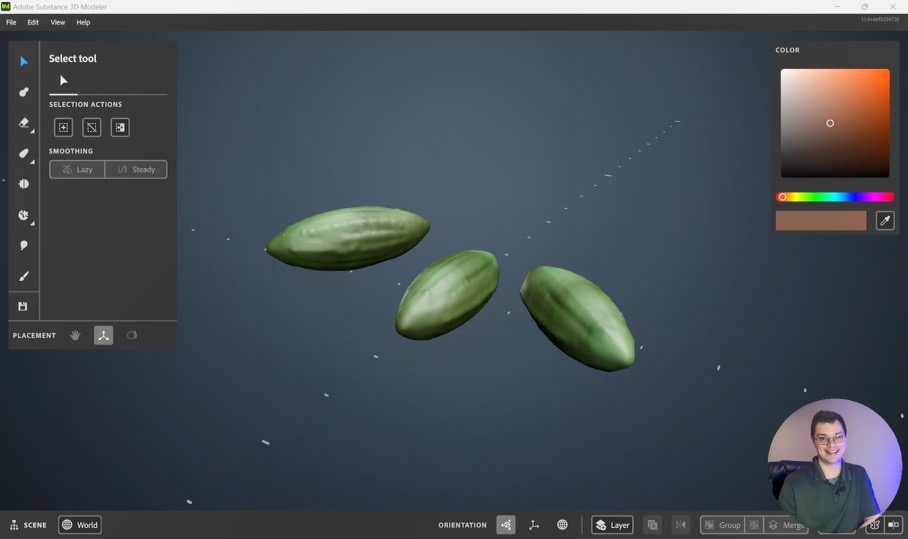
Check out what I came up with from using the rest of the tools!
Day 03 – More Tools – 3D Model 30 Day ChallengeLook I made some seed pods in the 3D metaverse!
Gamification became a hot topic, then a buzzword, and then LMS systems started adding badges for completing painful eLearning modules and calling it gamification. Now those not in Learning & Development see “Gamification” as a worthless fad because they don’t know what it is. Let me attempt to explain game-enriched learning environments.
As I was at my local gym, I found a PRECOR elliptical machine that let me log in and create a user name. I was hoping that this would allow me to track my usage on my phone and therefore onto the YMCA app where I track all of my exercises, but I am not that far in my Metaverse journey to awesomeness.
But now that I’m logged into this elliptical machine, it started to throw badges up on the screen when I hit certain landmarks over my entire elliptical journey.
You just walked across the Golden Gate Bridge! Your cumulative distance over time is the same as Taking a train from Beijing to the Great Wall of China!
NICE! Thanks, PRECOR! That makes me feel really good right now. I am motivated to exercise so these badges alone increase my motivation because I want to see what the next badge is. However, this on its own cannot be considered a game.
If these badges were used for unmotivated learners, then they would simply become asinine and probably, decrease motivation.
Often when I speak to experts, who are skilled and experienced in adding games to learning experiences, they tend to not like the word Gamification. It’s a dirty word now. Why is that? A lot of business leaders and learning stakeholders have requested Gamification in ways that don’t serve the learning model. Gamification is implemented without the funding or skill sets required to deliver.
For example, learning management systems have added only badges across-the-board, and called that gamification. Not even a leaderboard of who is ahead, just little images with arbitrary words like “HOT SHOT” and “ACE”. That’s not a game that is a reward that you could’ve won if you played a good game well to add merit to your performance. However, getting that badge after taking a raw DATA-DUMP in a trackable SCORM eLearning is more like a kick where the sun doth not shine than a game.
So, it has to be a good game and it has to build skills.
I like to think about games with learning purposes on a sort of quadrant.
First of all, is the game fun, or is the game not fun?
Second of all, does the game build skills are does the game not build skills?
( Skills here are skills that can be used in the real world. I would say Educational but that would be a circular definition and possibly a slippery slope that is not accurate. I have also hesitated in using the word Educational here because I don’t want to trigger memories of your teacher or mother asking if the show is “educational” or not? and now I probably triggered it anyway, which is good.)
Quadrant: Fun/not fun develops skills/ develops no skills
What are things that you can add to the games that make them great?
How do you make “FUN” games?
The game mechanics are the solution. (be sure to scroll down to the end to see videos of my favorite game.)
Game Elements
Believe it or not, there is a whole field around how to build games, and we are not just talking about video games here either. These ideas and tools work on all games from monitor and VR to paper and cardboard.
If you want to talk about building Gamified Learning Environments then you don’t have to look much further than the work of Karl M. Kapp. His book “The Gamification of Learning and Instruction” is basically THE BOOK.
Why are some games a one-and-done and others are repeatable? It has to do with the elements of the game, the interrelationship of the elements is what makes the game engaging. Games are based on models of reality known as operating models.
The benefits of abstracted reality:
Easy to understand complex concepts
Cause and effect are obvious
Removes extraneous factors which pose distractions
Reduces the time needed to grasp the concept
Goals
Game goals differ from instructional Goals. Game goals are specific and quantifiable. Instructional goals are broad and general. The final goal should not come too early. Ideally, there are sets of goals that build skill sets that are used to complete the final goal.
Operational Rules: Need the right key to open the right door
Constitutive Rules of Foundational rules: these are usually most important to the game designer. Probability of a die hitting a 6 or card counting
Implicit rules or behavioral rules: Govern the social construct between players. Usually tied to a penalty if broken.
Instructional rules: Define gameplay. The player must internalize before gameplay
Conflict, Competition, or Cooperation
Conflict is a challenge from a meaningful opponent and focuses on slowing the opponent down.
Competition is when a player is “constrained from impeding each other and instead devote the entirety of their attention to optimizing their own performance”.
Cooperation is working with other players to achieve a desirable outcome.
Time
Time is often used as a motivator to take action. When the clock starts. Time is also a part of helping learners allocate time to pieces of their work. The benefit of games is that they can condense time to view actions and results in real time.
Reward Structures
Badges, points, and rewards are not all bad and it is equally fun to let someone else know you received them. The leaderboard is a prime example of a reward where the user sees how they match up against all other players. It motivates additional play. It is best if rewards are directly linked to difficult accomplishments in the game. The text claims that LMS systems do not have corporate leaderboards but that might be dated information?
Feedback
Feedback is more frequent in games than in traditional learning environments. Robin Hunicke describes engaging feedback as juicy. Juicy feedback is tactile, inviting, repeatable, coherent, continuous, emergent, balanced, and fresh.
Levels
There are three types of levels: Game level, Playing level, and Player level.
The Game Level is useful for plot and storytelling. Skills can be built at each level. The level-up is a motivation to continue.
The Playing Level. A simple game is boring and an overly complex game is not fun. Therefore many games have an entry-level at the beginning, easy, moderate, and difficult. It is often helpful to have the first level as a demonstration with guidance and feedback on how to play.
APlayer Level relates to the character’s experience level or experience points in role-playing games. So, think Final Fantasy or Pokemon where a player has EP or “Experience Points”.
Storytelling
Storytelling can be as simple as the name of the game. It can be supported with minimal additions to create a plot. Today video games have huge storylines and back plots. Stories add meaning, provide context, and guide action.
The Hero’s Journey
The monomyth or the hero’s journey includes leaving the comfort of normal life and entering the unknown to battle the conflict. Stories like The Legend of Zelda and even Super Mario Bros build on the Hero’s Journey.
Curve of interest
Using “The hook” to move from this being a required training or an interesting topic toward the learner being excited about the learning experience. The entry point, is that it is mandatory learning, then the Hook where the learner’s attention is grabbed. Last is the climax and then the learning is over.
Aesthetics
Aesthetics range from the design of game board pieces to sweeping landscapes of imagined worlds. Game aesthetics relate directly to Learner Experience (LX).
Example
While we are discussing game aesthetics, I would like to share one of my favorite games. Simple to play, yet complicated to solve. I love this game so much that I think it deserves its own post. I played Monument Valley available on Apple Arcade and I couldn’t wait to download Monument Valley 2+ available on the same platform.
These videos are best viewed on YouTube using a smartphone. (Just click on the YouTube icon on the videos to play there.)
Work Cited
Kapp, Karl M., 1967-. The Gamification of Learning and Instruction: Game-Based Methods and Strategies for Training and Education. San Francisco, CA :Pfeiffer, 2012.
Salen, Katie, and Eric Zimmerman. Rules of Play: Game Design Fundamentals. Cambridge, Mass. The MIT Press, 2004.
How do we use our professional lives to better our private ones?
Do we learn more from our teachers or from our peers?
I attended my first DEVLEARN Conference this year. It was a pivotal moment in my career because now I know much more about what I don’t know. In addition, I gained direction, motivation, new career idols, and a plan.
In the learning space, we talk a lot about how deep learning comes more from peers than from professors or teachers. At DEVLEARN I attended a podcast session led by the great Betty Danowitz. I want to be honest that I learned a lot from Betty in that session.
Since Betty is a skilled training facilitator, she allowed the room to provide ideas to support her points. One of these ideas was from Matthew Pierce (whom Betty verbally praised approximately 15 or more times in the class). He shared that a way to back up a podcast for free is to publish the audio to video with a static image of your brand. Then upload to Youtube.com as unlisted to house unlimited audio.
When I ran out of space on my Apple account for photos and video, I was asked to start paying $10 a month to upgrade my plan. It took me a moment to connect the two ideas, but I have decided to use the video I take on my cell phone to create family videos and post them as unlisted to Youtube.com. I read that listing the videos by date in this format [YYY-MM-DD] will automatically list them in the order of the date of recording.
In the process, I am:
Backing up family memories for future generations
Saving money to build wealth for future generations
have a new creative outlet
Here is an example of one of these videos (which I got a little carried away with).
We Saw an Ow
This is a small example of one way I have used an idea I gained from my professional journey to benefit how I live my personal life.
What tricks have you learned on your career journey that you have used to better your personal life?
In what ways could you improve your personal life from skills you gained from your professional life?
In my previous post, I dug deep and shared about a position I held as an Instructional Designer; where I was not passionate and my skills were not well aligned with the needs of the learner. So, here are the top 5 things I learned from the most challenging Instructional Design job I have had so far.
Let Go, Your EGO
Think less about how you are being perceived by others, Focus on the value you can add to the business.
I was trying to add value to the department I was serving. However, I was thinking too much about myself and not enough about the needs of the business or, more importantly, the needs of the learner.
Let Your Interests Guide you
Do not work for an industry you are not pasionate about, seek out your passion.
This topic almost seems idealistic because we have heard it so much. In my current position, I am engaged because the industry I serve is electrical components and electric systems. I find it terrifyingly interesting. When I worked at insurance I felt a bit like I was serving an economically dark lord. I realize I was not working for the satan, but from my perspective, according to my truth, I might as well have been. A person much wiser than I once uttered, “
“Choose a job you love and you’ll never have to work a day in your life” – CONFUCIUS
Strive for New Skills
Do not fall back on the skills you have, Seek out new skills.
It is easy to skate by on the skills that have served you best in the past. However, as a learning professional, “The way we have always done it” or “I’m going to use the tool I know best” does not always produce the best outcome for the learner. So, as a principle, force yourself to seek out new tools and identify where they would be useful. However, do not use them simply because they are new.
Enhance, Don’t Rebuild
Use the tools already in place, and then enhance or build on them.
This is huge, and this ties directly back to letting go of your EGO. Don’t build something new just to say, “Look, I made something new.” Often times what is in place is working so don’t touch it. Instructional Designers and even higher-level learning architects do not have to be Organizational Development experts. It’s not our job to reorganize the business so it works better. (Although, sometimes it feels like the fails of business structure are flung onto the easy targets in the training department.)
Use the systems that are in place and find ways to enhance the way people interact with them.
If learning content exists then use it and build on it, do not scrap it and start over unless you have to.
Learn From Failure
Learn From Failure
Don’t let your ego get in the way of learning new skills, fail head first with passion and then learn from your mistakes to improve.
If we do not feel comfortable failing, then we never truly grow.
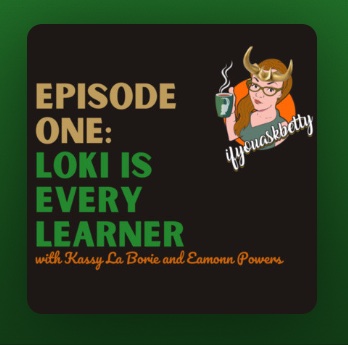
I recently completed listening to the LOKI series on the If You Ask Betty Podcast, where Betty and her guests discuss how LOKI is every learner and our goal is to find and reach for our glorious purpose.
Another key point in the 5-part series by BettyDannewitz is that failure is fundamental in this process of discovering your glorious purpose. In the Television show by Disney+, LOKI (link to trailer) fails so bad that we can perceive him as an anti-hero. However, when LOKI meets Morpheous and is really challenged to the core, his path diverts, he can start to embrace his failure as legitimate and use that experience as a moment of learning.
“A person who never made a mistake never tried anything new.” –ALBERT EINSTEIN
—Albert Einstein
Did you know that Albert Einstein could play the violin?
In my previous post, I promised I would follow up with a work project that in many ways failed, but then I used it in a project and painted it as a success for a school project. Well, I want to open up by sharing that I do not like the idea of insurance. I like having insurance on the things I can’t afford to lose (like my kids) but other than that I desperately hate insurance. So, how did I get experience working as an ID on my resume? Well, I temped for local investment firms that needed some hands and I got some solid gigs at a few local insurance companies.
Would you like some background music to enjoy while reading this? I recommend some Golden Dust by A.L.I.S.O.N.
I would like to try not to make this a gripe session but rather flip this over and use it as a case study in itself. If you would be so kind as to reply and share how you would have approached this assignment differently I would appreciate it. When I went to find the original case study/ web post I created for school (referenced in the previous blog post on honesty) I was shocked to see it in disarray. On top of not doing well on the work assignment itself, it appears as though I did not do well on the web page glorifying it either. Instead of copying the content into a new web page that I owned, I did a facelift on the actual school project from green to light blue. You can see how well this all turned out in the evergreen timeline here: curriculum effectiveness enhancement
If you haven’t read my previous post on HONESTY (which you should!) you might be asking yourself: “Why is Improvement Dave sharing all these fails he had? Isn’t this web page supposed to be teaching me how to live an awesome life?” Well, I want to candidly illustrate mistakes I have made in my career as an instructional designer in an attempt to foster moments of learning. My end goal is to ask you how you would have done things differently.
*The image looks better with red and blue 3D glasses.
So, back to why that web page, (linked above), looks so bad. I created this case study for school around a project I had at work. Then, I wanted to use it in my portfolio (also a school project originally). Instead of creating a new web page, I just threw a blue background up that hid the links to the other student’s pages and posted it on my portfolio. This was a lazy choice, and now I have a web page that has errors and I no longer have access to update them. Also, I wanted to make it all about me, granted it was for my portfolio, so again, I should have just created a new web page with the same content. (Which is what I plan to do nextSure, it would have taken more time to create a second version of the page, but it would have been free (with some ads) and I would now have access to edit it. When I was thinking about writing this post, I had the thought to recreate the web page now so I can use that for this case study, of a failed case study, presenting the ultimately failed project at work, but that didn’t seem honest. The whole point of this is to create a moment of learning from my mistakes, so fixing just one part of this seemed to take away from that learning. I need to fail hard, and I need to own that as a moment of learning. So, if you take anything away from this post, it should be:
“Don’t be lazy, like Improvement Dave was before he was awesome as FCUK.”
So, since that web page has a dreadful dark green background behind black text, making it nearly illegible, I can recap the project here:
I would like to start by saying this was a project for an insurance company in the claims department, but I am very ashamed to say that I have worked at multiple insurance companies and yes, supporting training for their claims department. Let that be your second lesson. Don’t work for a claims department at an insurance company (I am kidding! If you like that then more power to you, you sick and demented person.) So, my point in this paragraph is, I will try to leave the company anonymous.
Excuse #1
The previous person in my role quit right before I started. I was asked to train the higher-level claims analysts, who traditionally were promoted into this higher-level role. A decision was made to hire for this analyst role off the street as long as applicants had claims processing experience. I am using this as an excuse, but I want to illuminate the fact that the learners traditionally would have had 5 to 10 years of knowledge about how this company processed claims for all the different health plans they supported.
Excuse #2
I attended a condensed version of “how to process claims at this company training” that was led by the previous claims trainer to the one who had just quit. I had missed the first week or two of that course. I then attended a 2-week training that was led by a SME. I politely asked if I could record the training so I could use it for content design and development purposes and the SME declined. The training was broken up by type of claim. The SME processed a claim on the projector and then we were given claims on our laptops in class to process. In this second class, I was seated next to claim processors who had excelled at processing claims and had then been promoted to this higher level. At this point, it was clear to me that I did not know what was going on and that I was walking down a treacherous path. When this training concluded the SME who was training the course promptly quit his job, and in retrospect, I probably should have done the same thing.
ADDIE Time
I did not quit. I proceeded to leverage the ADDIE model to develop PDF Learner Guides and Facilitator Guides for ILT, based off of the Analysis I created from the SME training I attended. My first cohort arrived to me when I was about halfway through developing my curriculum. At this point, a second claims trainer was hired who attended the basic claims training and started building Learner Guides and Facilitator Guides for the ILT sessions they started leading.
Escuse #3
There were still two claims auditors on staff who had a 2-pronged job. When they were not auditing claims, they were working on updates on the “claims manuals”. These Microsoft Word documents were linear written descriptions of the process to complete common claim types that were stored on SharePoint. The Claims Manuals had minimal images only where necessary and contained multiple contradictions. It was difficult to search for them and nearly impossible to search them for content matches. If you got a claim you had to know what manual you needed and you had to know the title of that document.
After completing the Learner Guides and Facilitator guides and peer-reviewing the content through identified SMEs we both started getting questions about why we didn’t just train from the hundreds of Claims Manuals. We explained that the Learner Guides contained visual learning tools that explained the concepts around how the claims were to be processed not only the steps and that the Learner Guides always contained links to the relevant Claims Manuals. When I wasn’t updating my training guides I was leading back-to-back training cohorts. In retrospect, I should have made more time for actually processing claims. However, that time was cut into by having to train new hires.
Since the training really wasn’t going as well as I had hoped and the learners were not getting as much hands-on experience with processing claims as I would have liked. I started to ask high performers if I could record their screens while processing common claim types using the claims manuals and then use those videos as learning resources. Many of the new hires liked the videos because they could be replayed, which helped them encode stronger mental models to build from. However, the auditors and other members of operations did not approve of the videos. I also invited high-performing processors into the classroom to provide live demos. These demos were helpful but took high performers from the floor, and resulted in me developing a case of imposter syndrome. I would go home feeling drained and expendable.
It was at this point, that I started applying for jobs outside of the company full-time. I could see that my training was not delivering the results that I desired. There was tension within the department around how certain claims should be processed and new hires were often surprised by how claims were being processed for so many health plans with such few resources.
After that, I accepted an offer outside of the company and put in my two weeks’ notice. My team had a very nice going away party for me. However, when I invited members from the claims department to a happy hour at a local restaurant, only two people attended and one of them was from my department. This is not how my going away happy hours usually pan out.
This post has become a cathartic rant about a job that I feel bad about. It feels good to write it but I think I might have lost the point of this, which was to present it as a moment of learning. I am still curious to hear how you would have approached this assignment differently. What tools would you have implemented? What choices would you have made? What would you have demanded?
In my next post, I will dig into the takeaways I gained from this less-than-ideal experience.
I have been stuck in survivor mode for what seems like years. I knew it was happening but didn’t know what to do about it. I heard my heroes on the Bigger Pockets real estate Podcast warn about the pitfall of analysis paralysis, and their solution was to buy your first house. Well, I did that, and then I did it again turning the first house into a rental (as was the plan). If I am being honest it was not a smooth transition. Que the music Bill.
Purchasing a new home by writing my own contract from a template and using a local title office, then rehabbing said new home, while launching my new real estate rental business in the midst of navigating a job change into a department I was unprepared for at work; it does not seem like that much until you consider we were having our second child while fixing up the room she was going to sleep in (painting the room pink, below) and the carpet team the previous homeowners set up were attempting to jack up their prices and sharing they might not be able to install before the baby was due. Oh, and did I mention I was not thriving at work?
So, it happens, life is not always smooth and it does not always go according to plan. To borrow a Stephen “Covey-ism”, the problem is not the problem, it is how we perceivethe problem. In other words, it is the choice we make after the conflict arrives that is important. Do we choose flight or flight? or is it really as binary ☯️ as that? Do we have other options? Yes. Yes, we do. The “pause and pivot” come to mind. The old “accept failure as a moment of learning” is a way for us to accept that we failed, move on, embrace the fail, own it, learn from it, and hopefully grow.
I haven’t posted here in years, but now I want to be honest. I want to be candid and transparent. I stopped posting here because I wanted my posts to be genius. They had to be perfect or nothing at all. I was slave to the analysis paralysis that I had learned about from Brandon Turner on Bigger Pockets. This was a blog that I set up while getting my masters in Instructional Design. Oh, did I mention I was also doing that when I stumbled into survivor mode?
Yes, I was working nights and weekends to get a Master of Science in Instructional Design and Educational Technology. I am just going to gloss over how amazing it is that my wife stayed by my side during this time of turmoil. This blog is something that I had every intention of keeping active, and I am dreaming that starting this back up could be one step toward moving back into a state of re-engagement; to thriving.
I would like to thank all of the kind and inspiring people I met at the 2022 DevLearn Conference held by The Learning Guild in Vegas. A special thanks goes to the one and only Betty Dannewitz, from the ifyouaskbetty podcast, and her masterful series on LOKI the god of mischief. Thanks for kicking my ass Betty.
So, what next? Well, I have a project that I put together during this point in my life when I tried to do all the things at one time. It was a school project so, of course, I made it look as good as possible and painted it as a success, and slapped it on the front page of my LinkedIn profile. Like a total FCUK-ing liar. It is a case study around that new position I got at work, remember that? The one I desperately failed at? If I am being honest, I could have made it work, but I was in survival mode, remember? I didn’t want to learn the backward process that supported a company, with a mission I was not passionate about, and pour it into PowerPoint decks, I had already done that many times previously and I longed for something new. So, I just went through the actions, while looking for a new job and “running” my new business, but that is a story for another post…
In my next post, I will share that project, illustrate how it failed and ask you how you might have tried something different. It doesn’t have to be something brilliant, just something real.
If you have ever had the opportunity to work with a Learning Management System (LMS) then you know they can be a step less than friendly. In addition, if you have had a chance to work with a few different ones you might have noticed that they are definitely not all the same. In this blog post I review three of the LMSs that I have had the most experience with and some of the take-aways that I have from working with them.
The main boasting point of Share Knowledge LMS is that it integrates with SharePoint. This makes having content available on the company’s SharePoint site easily assigned to learners in online courses. The downside is that you have to deal with the antiquated system that is SharePoint, but many companies still seem to be happy doing just that so this is also a very attractive option for that reason.
There is not a lot to be found online about how to use ShareKnowledge but if you are using it they have a superb Customer Service department that is more than willing to work with you over the phone or email to assist you. In fact they will even accept zip files of eLearnings that are not working on their LMS and test them for you on their end. This is especially helpful in diagnosing issues.
Another thing that Share Knowledge seems to do rather well is integration with other Microsoft products. For example, Instructor Lead Training (ILT) that is available in Share Knowledge will automatically send class participants emails and create calendar invites in outlook.
As its name implies, Schoology, sounds like more of a classroom system that is used by schools. In fact Schoology has a thriving Corporate user base. The one thing that Schoology does support is an online learning community. It has a very well developed user forum function that allows users to interact in a social-media-type dialogue. Not to say that other LMS options do not have this function, it is just that Schoology does this especially well.
Schoology has many options in creating diverse online courses rich in multimedia. There is also an adequate quiz function that can automatically score multiple choice questions and pend short answer questions for review by the facilitator / instructor. Overall Schoology is a user friendly option that creates a strong sense of community.
SABA LMS is marketed as a “global learning management” tool. It has a very well developed online forum that has a very active participation from users around the world. To be honest you will need it. SABA is very powerful and can do many things very well. With all of the options that SABA offers it can be daunting to find the path to the option you want. However, when all is said and done the designer can find what they are looking for in the online instructional resources and forum.
The trade off is a very seamless experience for the user. SABA is extremely intuitive and users are generally very happy with the experience. There is a very nice 5-star-rating and written response for content that is simple to turn on and gives user the ability to provide instant feedback on learning materials.
Author
David Kolmer is a Learning and Development Specialist who focuses on curriculum development and eLearning authoring.
To create inclusive learning environments that provide opportunities for all learners to improve regardless of ability. Leverage technology to implement relevant, interactive and cost-effective learning environments that promote learning through exploration.
David Kolmer 2018
As an instructional designer, I am obviously interested in every step of the standard ADDIE model. However, my creative spirit lends toward an AGILE development style.
I am involved in Assessing, designing, developing and implementing any given curriculum but tend to submit my material for evaluation while developing various iterations.
My emphasis for my Master’s degree at Fontbonne University was Learner Experience.
I believe that the environment that the learners find themselves in is fundamental to their success. A calm and peaceful environment is much more conducive to learning than a loud and overly critical environment.
Learning Opportunity for All
The word “inclusive” and the phrase “all learners” were selected deliberately. In, the course: Current Topics in Universal Design, JoAnn Mattson, the director of eLearning at Fontbonne University, introduced me to the CAST organization which included UDL or Universal Design for Learning.
We were asked to submit all work within the guidelines proposed by this platform. It was not a difficult decision for me to agree that all learning materials should be accessible to all people regardless of their ability. Audio files should have text-based transcripts, texts should have audio options and text should be in a larger 14 point font, physical activities should have text-based options. In this way, the facilitator will be prepared for any student with any set of abilities that enters their classroom. CAST (2018) I am not addressing the learning styles of learners as that concept never appealed to me much and as it turns out there is little to no evidence to support the theory of learning styles. (Husmann and O’Loughlin 2018)
e-Learning or e-Boring?
In the second sentence of my mission statement, I brand effective use of technology as creating “interactive” and “cost-effective” learning content. Much has been written about the mass exodus of corporations from instructor-led content to the use of e-Learning as a way of decreasing costs. Normally, these articles and blog posts are linked with the opinion that a majority of this e-Learning content does not promote actual learning. This is why I have chosen to add the element of interactivity. It is all too easy to generate a quick e-Learning that serves as a “data dump”. However, generating an e-Learning module that engages the student and provides the environment conducive to learning requires skill and an understanding of the principles of andragogy. It is an art that has been hastily presented as a simple task that can be easily replicated.
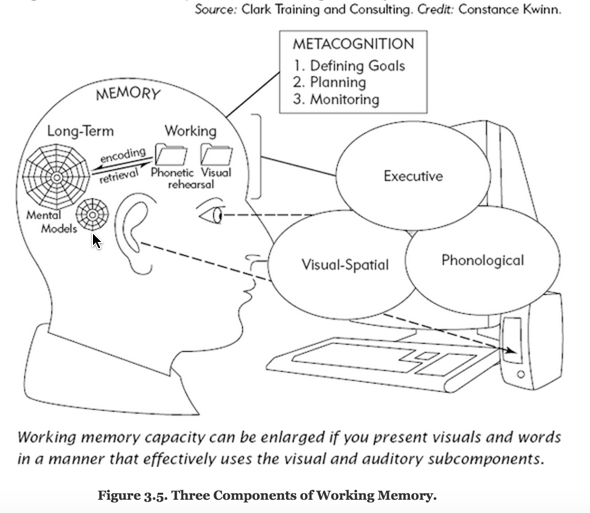
Relevant interactivity is one of the most crucial elements of effective eLearning modules. These are not necessarily simulations that are specifically “learning by doing”, although they could be. What is really at play here is having the learner focus their attention on content to enter it into their working memory. Then, time is given for the learner to process the information in multiple ways (we often refer to this as a reinforcement activity). However, in my mission statement I have chosen the word “exploration”. This increases the probability that the learner transfers the information, or encodes it, into mental models in their long-term memory. (Clark 68-69) If this is done effectively, namely with a relevant context, then knowledge transfer back to the working memory can be achieved when needed. (Clark 253-254)
Image Courtesy: Ruth Clark and Chopeta Lyons, Graphics for Learning
Or as Clark writes it:
“There is little value to mental models in long-term memory that cannot be retrieved back into working memory when needed on the job.”
(Clark 254)
On an even more personal note, I first decided that I might be interested in instructional design because of a set of e-Learning modules I took while working at Lowe’s Home Improvement. The tagline at Lowe’s was “Never Stop Improving” and I could work with that, these e-Learning modules were bland “data-dumps” with faulty multiple-choice quizzes. I wanted to know how those modules were created, because I felt I could do better, and that is when I started on my interest in Instructional Design.
Clark, Ruth Colvin. Building Expertise: Cognitive Methods for Training and Performance Improvement. Pfeiffer, 2008.
Husmann, P. R. and O’Loughlin, V. D. (2018), Another nail in the coffin for learning styles? Disparities among undergraduate anatomy students’ study strategies, class performance, and reported VARK learning styles. American Association of Anatomists. . doi:10.1002/ase.1777
Let’s face it, cartoons are fun to watch and if we are really honest with ourselves we have learned a lot from them.
I am interested in improving my skill-set around creating video shorts that explain a complicated idea in a short, light and easy to consume cartoon. I have seen similar content done on Prezi but really, although I do like digital zooms I really feel like that sort of presentation is really just a PowerPoint with extra bells and whistles to distract participants from the content. Especially now that PowerPoint has introduced the “Morph” Transition. I know it is a popular platform but I have heard a wide range of mixed responses to the platform. Some have even said that it makes them feel sick. Besides, a formal presentation is what I am trying to move away from. As I said, I want to make a narrative cartoon.
I had done some work with Animoto and it is a wonderful online app that is fast and very easy to use. I had not seen many ways to do much more than an animated slideshow with the Animoto platform so it really does not speak to my need.
I found an app called Wevideo that looked at face value like a simple online video editor that you might compare to a souped-up version of the legacy Windows moviemaker that came standard on Pre-Windows 7 Operating Systems. When I have some raw video that I would like to edit I look forward to leveraging that platform, but again I want to make some cartoons.
So then I narrowed it down to two platforms that I felt might be able to create something that I am looking to do. Powtoon, Vyond and GoAnimate stood out as industry standards which aim to do exactly what I want. Start with some audio and quickly build out some cartoons around the story. I researched both and at face value, GoAnimate seemed like the higher-shelf product. It had very modularized backgrounds or sets I would even call them, gobs of props, and characters complete with emotions and animations. The item the sealed the deal was they have the voice to lip sync technology (which I later found is not part of the free trial) that makes the characters actually move their mouths in sync with the vocal audio (but you know, like cartoons do.)
Powtoon was attractive simply because it also looked very good. The animations looked very colorful and compelling. The backgrounds looked great if not as adjustable as the sets on GoAnimate or Vyond. The attribute that made me really long and hard at Powtoon was they have a permanent free option whereas the lowest level on GoAnimate (after a 15-day trial) was $50 a month. Not bad if you make cartoons for a living but too much if it is just something you do once in awhile.
So I have decided to try out both Powton, Vyond and GoAnimate. So far I have only created a short 1 min. video in GoAnimate and I absolutely love working with the platform. I had a beer and knew my way around before the beer was finished. Not bad… Not bad at all. An hour later I have a link to my final product. What did I learn? With the free trial, GoAnimate will place a watermark on the whole video, whereas friends at work have shared that PowToon just pops in a little icon on the bottom corner of the screen. The same is true with Vyond. Powtoon is the lowest pricepoint, and higher than that would be GoAnimate. In my opinion the most expensive platform, Vyond, is worth every penny. There are just so many more characters, set peices and automated animations. In addition set peices themselves are moveable.
Here is an example of a cartoon I created on Vyond:
This blog post explores the idea of leveraging Podcasts to support the learning and instructional process. With the connectivity of the Internet age and the increase of social learning, Podcasts have become a very popular way for people to learn new ideas and gain new skill-sets.
In my personal life, I have enjoyed the narrative of podcasts like Radiolab, Serial and S-Town. Although these podcasts are true stories, that are gripping and enlightening, they do not necessarily build a definable talent or even marketable knowledge, or do they? These immensely popular podcasts do generate a deeper understanding of the human condition and I have enjoyed them immensely. If nothing else they increased my sense of empathy for other people who are not like I am. Did they teach me a new skill? Well, no, not really but does all learning need to give you a practical skill?
HEY! I work for The Man.
So, I am looking at this from the corporate perspective simply because I am currently employed as a corporate trainer, working for “the man”. From my perspective what is learned is defined by business needs and ways to increase the profit margin. When you introduce a topic, in the corporate training environment, you list the behavioral learning objectives using verbs that describe what learners will be able to “DO” (to better serve the business) at the end of training. I do not mean to cheapen the concept of what learning is, much the opposite in fact. So, with that in mind let me dream about pure learning for the sake of learning, say at a school…
Podcasts in Class?
In his article for The Atlantic, Michael Godsey, shares of his difficulty to get students to read but how he discovered the same students were activity engaged in discussing podcasts, such as Serial, outside of class. He even compares this difficulty to adult’s excuse that it is hard to find the time to sit down and read but Podcasts, on the other hand, present a learning modality with a different set of rules. So, he introduced a unit that leveraged the engaging power of the Podcast. Michael shares are feelings on the subject:
“While I felt guilty the students weren’t reading very much during this unit, their engagement with a relevant and timely story—their eagerness to ask questions, their intrinsic motivation to use critical thinking—seemed to make it worth it, at least temporarily. The students voluntarily studied maps, evaluated clues, argued with each other, and wrote twice as much in their journals as they previously had.”
There are other Podcasts that I have enjoyed in my personal life that I feel have come closer to teaching me an actual skill. Freakonomics is a podcast that I have listened to the most. This show aims to debunk common misconceptions of the modern world through the discoveries of Economics. Branding themselves as “The hidden side of everything” they ask experts in niche areas of Economics to share what they have deduced from their data-sets. If nothing else this show has helped me think more critically and analytically. Stephen Dubner and Steven Levitt, or the Steves, got their start on the subject by co-authoring “the book and blog by the same name” and then decided to break into the Podcast space. I for one am certainly glad they did.
This podcast (and Blog) work in with my Personal Learning Network because the content cuts through all of the emotional baggage and lies we tell ourselves. We are looking at data to locate the truth and it is less important how we feel. An instructional designer must use a needs analysis to find the truth of what is really needed by the learners. It is up to them to build the curriculum around those needs and involve actions that train to those needs, not use some activity they like which does not serve the higher purpose of what needs to be learned; or use the latest trick in Captivate or Storyline to make them look fresh and cutting edge. In addition, serving the needs of the learning is also up against resistance from business leaders who want to add insignificant granular details or destructive animations and sound effects to the training. A true ID will stand up for the truth. They will become an outsider and build a training that will actually improve the world. Not just add more noise.
Another Podcast that I think does a fantastic job of training people in their everyday lives to build a valuable skill-set or knowledge base is The Bigger Pockets Podcast. The Bigger Pockets team actually started out by creating a social network around real estate investments which has grown to be one of the (if not the biggest) to date. Biggerpockets.com is a social media site of sorts where you can log in and network with other real estate professionals (and novices) from around the world to grow your real estate prowess. At one point the creators noticed that their plan had actually worked so they decided (the verdict is out on who decided to) start a Podcast. Now, over 200 podcasts later the show is a smash success.
The reason the show works as a learning model is that it relates to the listener on a social level. Joshua Dorkin and Brandon Turner are not afraid to take cheap shots at each other and even throw in some amazing (as well as questionable) humor when they speak with their incredibly successful guests. This realness of the show leaves the listener feeling as though they have simply met up with the team at a coffee shop or bar somewhere and are listening in.
As studies have shown, this communicative storytelling narrative drastically increases knowledge retention. Research supporting the personalization principle shows that more knowledge is retained when it is presented in a conversational tone. (Moreno and Mayer 2000) Similar to Freakonomics the Bigger Pockets crew also invite the best of the best on to their shows, subject matter experts if you will, who have amassed millions of dollars through real estate and are proven experts on the subject. So, you know you are getting solid methods that have been tested in the real world. One of my favorite parts of the show is they ask every guest what their favorite real estate book (that they did not author) is. In this way, I have discovered (and read) numerous books on the subject that I otherwise might never have heard of.
At this point, the interview with Austin Fruechting is still one of my favorites. Check it out here.
The Bigger Pockets podcast is a large part of my Private Learning Network (PLN). I am a designer, a performer, a teacher, a trainer and I am an instructional designer with an emphasis in Learner Experience. The interest I have in these topics revolves around a love of learning and sharing what I have learned. However, when I have achieved a certain amount of capital it is real estate that I am ultimately interested in. I like buildings, I like houses and I am excited by the prospect of owning more of them… Ultimately, I would like to design learning content around real estate investing but I am simply not there yet.
So what are your thoughts? Have I convinced you to use Podcasts in your teaching or training efforts? Please leave your thoughts below.
And if I have convinced you then check out this list of featured Learning Podcasts that were hand selected by our friends at Player.FM
work cited
Monero, R.& Mayer, R.E (2000b). Engaging students in active learning: The case for a personalized multimedia message. Journal of Educational Psychology, 93, 724-733.























 Improvement Dave