
Featured Image: https://pxhere.com/en/photo/848203
Personal Vision Statement
To create inclusive learning environments that provide opportunities for all learners to improve regardless of ability. Leverage technology to implement relevant, interactive and cost-effective learning environments that promote learning through exploration.

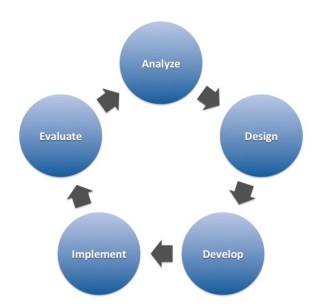
As an instructional designer, I am obviously interested in every step of the standard ADDIE model. However, my creative spirit lends toward an AGILE development style.
I am involved in Assessing, designing, developing and implementing any given curriculum but tend to submit my material for evaluation while developing various iterations.
My emphasis for my Master’s degree at Fontbonne University was Learner Experience.
I believe that the environment that the learners find themselves in is fundamental to their success. A calm and peaceful environment is much more conducive to learning than a loud and overly critical environment.
Learning Opportunity for All
The word “inclusive” and the phrase “all learners” were selected deliberately. In, the course: Current Topics in Universal Design, JoAnn Mattson, the director of eLearning at Fontbonne University, introduced me to the CAST organization which included UDL or Universal Design for Learning.
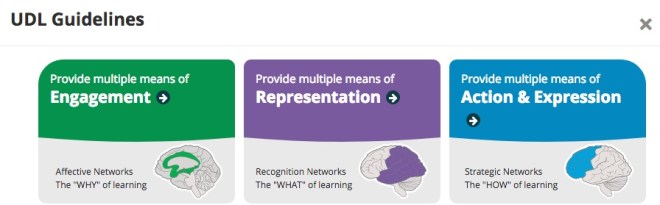
We were asked to submit all work within the guidelines proposed by this platform. It was not a difficult decision for me to agree that all learning materials should be accessible to all people regardless of their ability. Audio files should have text-based transcripts, texts should have audio options and text should be in a larger 14 point font, physical activities should have text-based options. In this way, the facilitator will be prepared for any student with any set of abilities that enters their classroom. CAST (2018) I am not addressing the learning styles of learners as that concept never appealed to me much and as it turns out there is little to no evidence to support the theory of learning styles. (Husmann and O’Loughlin 2018)
e-Learning or e-Boring?
In the second sentence of my mission statement, I brand effective use of technology as creating “interactive” and “cost-effective” learning content. Much has been written about the mass exodus of corporations from instructor-led content to the use of e-Learning as a way of decreasing costs. Normally, these articles and blog posts are linked with the opinion that a majority of this e-Learning content does not promote actual learning. This is why I have chosen to add the element of interactivity. It is all too easy to generate a quick e-Learning that serves as a “data dump”. However, generating an e-Learning module that engages the student and provides the environment conducive to learning requires skill and an understanding of the principles of andragogy. It is an art that has been hastily presented as a simple task that can be easily replicated.
Relevant interactivity is one of the most crucial elements of effective eLearning modules. These are not necessarily simulations that are specifically “learning by doing”, although they could be. What is really at play here is having the learner focus their attention on content to enter it into their working memory. Then, time is given for the learner to process the information in multiple ways (we often refer to this as a reinforcement activity). However, in my mission statement I have chosen the word “exploration”. This increases the probability that the learner transfers the information, or encodes it, into mental models in their long-term memory. (Clark 68-69) If this is done effectively, namely with a relevant context, then knowledge transfer back to the working memory can be achieved when needed. (Clark 253-254)
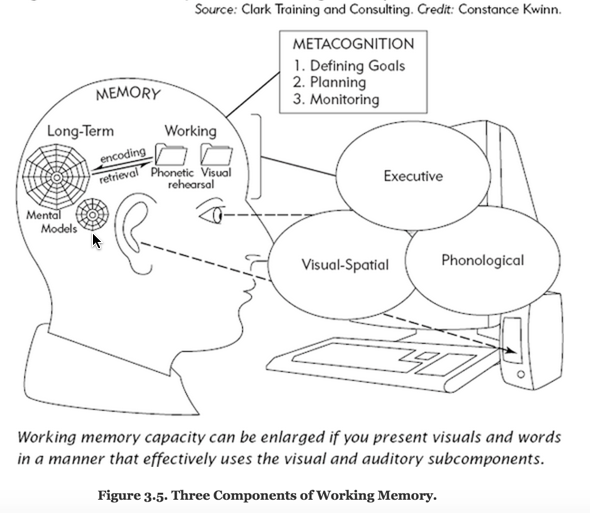
Or as Clark writes it:
“There is little value to mental models in long-term memory that cannot be retrieved back into working memory when needed on the job.”
(Clark 254)
On an even more personal note, I first decided that I might be interested in instructional design because of a set of e-Learning modules I took while working at Lowe’s Home Improvement. The tagline at Lowe’s was “Never Stop Improving” and I could work with that, these e-Learning modules were bland “data-dumps” with faulty multiple-choice quizzes. I wanted to know how those modules were created, because I felt I could do better, and that is when I started on my interest in Instructional Design.
works cited
CAST (2018). Universal Design for Learning Guidelines version 2.2.
Retrieved from http://udlguidelines.cast.org
Clark, Ruth Colvin. Building Expertise: Cognitive Methods for Training and Performance Improvement. Pfeiffer, 2008.
Husmann, P. R. and O’Loughlin, V. D. (2018), Another nail in the coffin for learning styles? Disparities among undergraduate anatomy students’ study strategies, class performance, and reported VARK learning styles. American Association of Anatomists. . doi:10.1002/ase.1777


