
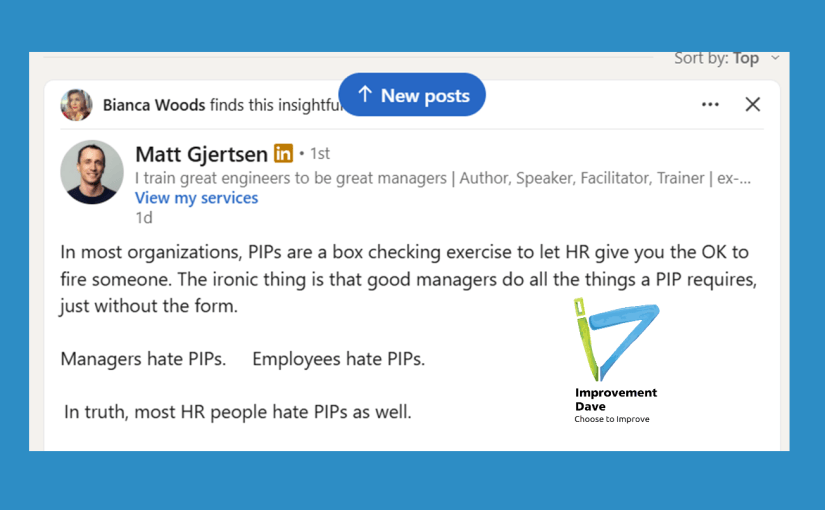
@Matt Gjertsen wrote an eloquent post discussing the value of Performance Improvement Plans (PIPs). I started a response, and it grew into something longer than a comment…

Dicotomy
I see two ends of a spectrum:
On one side, an agile-wise person has no goals; they ride the wave and keep the bow of the ship riding in the right direction, because all budgets are an estimate.
On the other side, the organization wants growth, and they need measurable outcomes to share with their investors.
I think somewhere in the middle we see a friction point.
Birthing Classics
I somehow always think of classical music in this case… Ludwig Van Beethoven invented the romantic style. He was a bridge composer who took us out of the traditional classical style of music. He was wild and passionate, unpredictable, and he made incredible art. He still wrote his music down so the symphony could play it… Before him there was another famous composer named J.S. Bach, one of my all-time favorites. Calm, organized, a self-taught family man who also created incredible pieces of art that we hold up on a pedestal as almost holy or Divine artifacts. One thing that they had in common, when they performed these pieces live, there were small embellishments, trills, and added melodies that did not appear in the written pieces. Where I really like to go with this metaphor is: what about when they wrote the piece to begin with? The ACTUAL WORK was when they were muddling around on a Piano Forte, knocking the piece out from a series of improvisations on the theme.
Connect Back
So, in the same way that a budget becomes reality when the time or money is spent, and adjustments need to be made in the moment, these musicians created masterpieces one moment at a time.
The performance improvement plan is a useful tool if you really want to see perpetual growth in your company. However, another way to look at perpetual growth is cancer. My personal opinion is that many of the behavioral health and overall biological dis-eases we see in the modern world are a function of this blind desire to continually grow and expand. I reflect deeper on this idea in a previous article. [Why Be Better?]
Back Home to the Big Box
After spending 7 years traveling the world teaching English, I landed a part-time job at Lowe’s to build up some work history. The store managers had to lead these daily meetings where they would discuss the daily growth and year-over-year growth. Some of them just went through the motions, and that was fine. Other managers presented it as if it was something that I should personally care about. Here I was returning home from a journey of international learning, and I found myself in a box making someone else rich… THEN they had the gall to think I cared how much money they made regardless of the absent affected my salary. It made me want to strike them in the face. Instead, I found ways to not attend these mandatory meetings.
Conclusion
Now that I am no longer an hourly front-line worker, I recognize the value of Performance Improvement Plans (PIPs) as a way to strengthen an organization. At the same time, I see them as a festering sore that likely causes more problems than it solves. If an employee is underperforming or acting against the company’s culture, they should be let go. A PIP is the right tool for that: shape up or ship out. Beyond that, PIPs are a waste of time.
“Simplicity is the ultimate sophistication.”
Leonardo da Vinci:


