The Sandbox Analogy: Embracing Unexpected Learning
Yesterday, my kids were playing in their sandbox. The weekend before, I had noticed that my daughter and her friend had shoveled all of the sand up to the slotted planked “walls” of the sandbox, and a lot of it had fallen out into the playground area. Yesterday, my kids filled that area with water, played on the slide, and got covered in mud. Now, I built that sandbox intending for my kids to sit in it, shovel sand into buckets, and play as if they were at the beach. How they chose to play in the sandbox doesn’t align with my original intention. And that’s completely alright.
AnInstructional Designer’s Journey: A Call Center Experience
When I first started exploring instructional design, I was working as a training facilitator at a call center for a popular credit card company. I reached out to an established instructional designer working at the flagship office in Ohio, to learn more about the🆔role. They shared a project addressing one of the most complicated phone call scenarios for credit granting—a situation where identifying the next course of action was particularly challenging, especially for newcomers who wanted to avoid legal missteps.
An E-Learning Solution That Became More
The designer’s solution was a basic e-learning module in a SCORM file. It featured a branching scenario that guided users through the call, complete with cute static cartoon characters. Intended as a classroom learning experience, it evolved into something more. Learners began using it as an interactive job aid during actual calls, asking clients for brief holds while they loaded up the e-learning module and then consulted the e-learning for guidance throughout the call. The instructional designer saw this as a complete success, as the artifact had transformed into a practical, continually used tool. The form of the learning artifact remained the same but the function or usage of the tool had pivoted.
Rethinking Learning Artifact Design and Usage
In learning and development, we often focus on creating artifacts that suit our own learning preferences. This natural and selfish process has been coined “Self-Hugging.” That is making learning content that we ourselves would consume easily. However, it’s crucial to design learning experiences that work for everyone, regardless of their ability or learning preference. The function of a learning artifact should be left up to the learner. Too often, we dictate how learners should use these tools, limiting their potential.
Embracing Learner-Driven Exploration
Just as children might choose to shovel all the sand out of a sandbox—not the intended use, but still valid—learners should be free to explore and use learning artifacts in ways that work best for them. This exploration can lead to valuable realizations. For instance, children might learn why keeping sand in the sandbox is important through their own experiences, rather than being told arbitrary rules. So there is a connection here between the corporate learner and the child playing in the box of sand…
Maybe they want to shovel all of the sand out of the sandbox. That’s not how I as an adult view correct play with the sandbox, but does that matter? Does that mean we can no longer consider what they are doing to be “Play?” They might find themself in a place where all of the sand is no longer in the sandbox and now it’s mixed with the wood chips, and it would be nearly impossible to get only the sand back in. Now they can’t play in the sandbox. At that point, they might realize that shoveling all of the sand out of the sandbox isn’t what they should’ve done; IF they want to play with sand in the sandbox.
The keyword here is “realization.” Simply because they did something wrong does not mean that the learning experience has failed in fact, quite the opposite. The participant will have gotten to a point where now they know why it needs to be done in a certain way because they have learned from their own firsthand experience that there is a rule for a reason. This will be 99% more effective than if you had simply told them, “Hey we do it like this, this is just how we do it because we’ve always done it like this.” In other words, there will be actual behavioral change, and moving forward, the culture will naturally align with the policy in a fortified way.
Embracing Learner-Driven Exploration
When learners have firsthand experience, they understand the reasons behind certain practices. This approach is far more effective than simply dictating rules without context. It leads to actual behavioral change and cultural alignment with policies. By allowing learners to explore, make mistakes, and come to their own unique realizations, we create more impactful and lasting learning experiences.
Hey, this is Dave. I am an Instructional Designer and learning experience advocate. I would like to discuss ways we as learning professionals can help learners on their journey. How Teachers, Corporate Training Facilitators, or Instructional Designers can “Get Out of the Way” of learners on their journey. This is not a new idea, but it is an important one.
Main Points
Use tools that help you stay in the learning game.
Write content that helps the reader improve on their own.
Sell your idea, don’t force it, Sell it!
Make the training about the real world, not academia or your world view
Serve the Reader
One way we can create instructional content that resonates with learners is to write better. Write simple statements that offer solutions and ideas that will help our learners. It sounds obvious when you say it, but somehow it helps to be reminded. In this article, I would like to pinpoint this concept, explore its meaning, and connect it to educational artifacts.
Expedited Audio Learning Tool
Here is an accidental win I had. Have you ever done a free trial of an app on your phone? Then you liked the app so much that you just never canceled it? It’s not something anyone would be proud of. I’ve had it happen at least once. OK, it was once because I do not spend money. It was the Headway app. This is not a paid advertisement for the Headway app… …but it should be!
My favorite app, I mean Blankest is good but Headway is BOSS!
I love the Headway app. It condenses books to their essence and then reads that summary to you, it also provides you a text summary. In this way, you can listen to 4 or 5 books while you say, mow the lawn. (Which is normally what I do while using the app.) I have
Listened to condensed versions of books I have never heard of
listened to condensed versions of books I have already read twice
discovered books I want to read and then went out and read or listened to them.
The topics are wide ranging. I have relistened to the 7 Habits by Stephen Covey. I learned about the Japanese Aesthetic of silence and somber inaction. I have trained my subconscious mind to generate creative solutions. I have gotten better at not arguing with my family. You tell the app what your interests are. Then it amazes you with content you never knew existed. It also reminds you of content you love.
Nobody Cares About You
The most useful book that I listened to on Headway is called:
This book falls into the category of: This is a book I like so much. I went out and read the original book.
I love the message of this short book:
Write clear and concise messages that help other people.
It really doesn’t get any better than that. People don’t care about you, they care about themselves. People like to read about interesting or novel things that will help them. Even if you write a story about yourself, you should not stroke your ego. Don’t make the book all about how you are the most amazing human ever in the history of the world. The focus is on the reader, how can you help them? After all humility is sexy. People want to be with other people who are humble.
Summary of the book, that I wrote on my iPhone while mowing the lawn.
As I mentioned I use this app while mowing the lawn. (OK, I took breaks from driving the riding lawnmower while I took these notes. I did not write these while I was mowing.)
This book will teach you how to write better
Delivery is critical, be proactive in finding ways to help others.
Always write in casual copy.
Never write in technical explanation. *Unless designing technical documentation or technical training.
People care about themselves. people do not care about you. So write for them. Write things that help them.
People respond to what is: new, novel, or helpful.
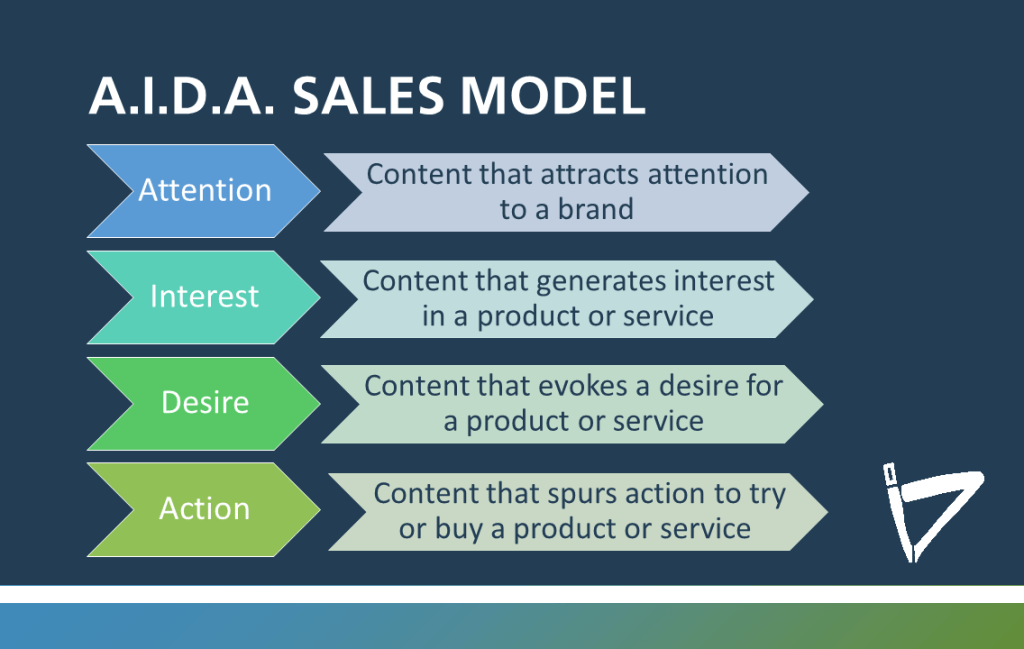
Use the AIDA sales Model:
Attention
Interest
Desire
Action
[End of the summary I wrote on my iPhone.]
So, we have a novice writer (yours truly). He is writing about being a better writer. He is also using a sales model to identify how to be a better educator. I want to drill down on the warning above about the tone of the writing. We should use casual copy to describe ideas to compose writing that is easy to read. Learning content should be straightforward. It should be easy to follow. It should use common words and not use complex language that the average person would not know.
This is because the reader (learner) will waste effort on figuring out what you mean. They will focus on looking up words or not really understanding instead of focusing on the message itself. In the Learning World, we discuss this using the phase, “Cognitive Load” but you already knew that… or you should have.
Definition of the A.I.D.A. sales model
Here is a definition of the AIDA sales model provided by Gemini AI from Google.com
The AIDA model is a marketing framework that describes the four stages a consumer goes through before making a purchase:
The acronym AIDA was developed by American businessman Elias St. Elmo Lewis in 1898 and has been in use ever since. Businesses can use the AIDA model to create effective sales pitches that resonate with prospects and turn them into customers by understanding and addressing each stage. For example, a salon might use the AIDA model to promote an opening by running a PR campaign before launch, offering free consultations, and hosting exclusive launch events.
[End of Gemini AI Summary from Google.com]
Oh, wow. Look at that AI writes really long sentences too. Now I don’t feel as bad!
Wait, is This Sales? Am I on the Wrong Vlog?
How can Learning and Development professionals apply this model to our work? After all, this is a sales model of all things. I would like to lean on my memory of writings by Daniel Pink here. I am evoking his book “To Sell Is Human.” This book was suggested to me long ago by a colleague. They saw that I just didn’t get it. I was being naive and idealistic in my approach to work.
I was acting as if it was all about me. Yet, counterintuitively I was being aloof. Self-deprecating humor is very useful when you are a corporate training facilitator, but it can go too far. I was not speaking well of myself all the time. I was chronically breaking myself down with self-deprecating humor. This wasn’t just humility, I started to believe it. I hypnotized myself into thinking that I wasn’t good enough.
It’s not about me, it never is. It is about us, working together for a better way. We have to sell ourselves to the people around us all the time. We have to sell the ideas we write about in our learning artifacts. Sales is good, it is healthy. It isn’t inherently sleezy, as long as you are being honest. So, let me rewrite this summary with an L&D bend:
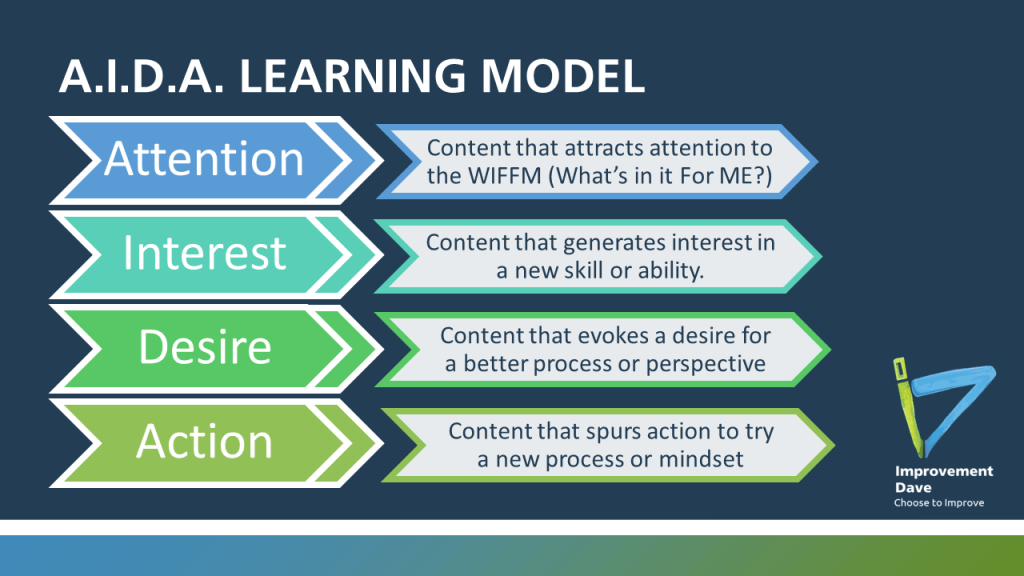
A.I.D.A. Learning Model
The AIDA Learning Model is not a real thing. I just made it up because this is my blog, and it just fits. A sales pitch is a perfect metaphor for well-written learning content.
It needs to be short and concise.
It needs to grab our attention.
It needs to tell us why we should care.
It needs to get us fired up to make a change.
If our learning content is not engaging learners in an experience. Then it is not a learning experience. Learners should feel encouraged to explore and think for themselves. Otherwise it might as well be compliance training on an LMS with a multiple-choice exam. That’s not learning, that is covering your legal ass-ets.
Another Short Book on Writing Better
I don’t think it is a coincidence that the other book I would like to mention here is also short. Writing better is about being concise. I already had a lot of classroom experience. I worked as a training facilitator at a call center in Bridgeton, MO. This experience was in front of audiences and classrooms. I didn’t have a lot of feedback (or feedback I was open to accepting) on my writing.
At one point, I had written an especially terrible email. One of the seasoned trainers handed me a small gray book. I will call him “Jim Simpson”, which is his real name. On the front, it said, ~~~ “The Little Gray Book” ~~~ Q. Wallace. I started reading it. It instantly pulled me in. It gave me ideas I implemented right away to improve the clarity of my writing. I can not recommend it enough to someone who wants to write better.
All aspects of our experience can help us better serve our learners. We better serve our learners and create learning content that truly connects with them. This happens when we give the best solution to potential problems. We should avoid just collecting cold facts or professing problems.
There is nothing wrong with using AI or ChatGPT and citing them accordingly. We should hesitate to send only what a search from these tools told us. These tools do not always write in the most straightforward tone. Nor do they always give the insider information we can get from partnering with an SME. If we share “real company culture” or “how they do it on the floor,” then we are helping the learners.
The learners will be more engaged. The more focused this solution is on their environment or job role the better this works. The more specific you can be on: what the solution IS the better the results. Share best practices. Explain how it works best. Provide tricks with “the system login”. Describe how it fails etc. The better the results. [This was the end of the post.]





 Improvement Dave