Case Closure

In my previous post, I promised I would follow up with a work project that in many ways failed, but then I used it in a project and painted it as a success for a school project. Well, I want to open up by sharing that I do not like the idea of insurance. I like having insurance on the things I can’t afford to lose (like my kids) but other than that I desperately hate insurance. So, how did I get experience working as an ID on my resume? Well, I temped for local investment firms that needed some hands and I got some solid gigs at a few local insurance companies.

Would you like some background music to enjoy while reading this?
I recommend some Golden Dust by A.L.I.S.O.N.

I would like to try not to make this a gripe session but rather flip this over and use it as a case study in itself. If you would be so kind as to reply and share how you would have approached this assignment differently I would appreciate it. When I went to find the original case study/ web post I created for school (referenced in the previous blog post on honesty) I was shocked to see it in disarray. On top of not doing well on the work assignment itself, it appears as though I did not do well on the web page glorifying it either. Instead of copying the content into a new web page that I owned, I did a facelift on the actual school project from green to light blue. You can see how well this all turned out in the evergreen timeline here: 
curriculum effectiveness enhancement

If you haven’t read my previous post on HONESTY (which you should!) you might be asking yourself: “Why is Improvement Dave sharing all these fails he had? Isn’t this web page supposed to be teaching me how to live an awesome life?” Well, I want to candidly illustrate mistakes I have made in my career as an instructional designer in an attempt to foster moments of learning.
My end goal is to ask you how you would have done things differently.

*The image looks better with red and blue 3D glasses.

So, back to why that web page, (linked above), looks so bad. I created this case study for school around a project I had at work. Then, I wanted to use it in my portfolio (also a school project originally). Instead of creating a new web page, I just threw a blue background up that hid the links to the other student’s pages and posted it on my portfolio. This was a lazy choice, and now I have a web page that has errors and I no longer have access to update them. Also, I wanted to make it all about me, granted it was for my portfolio, so again, I should have just created a new web page with the same content. (Which is what I plan to do nextSure, it would have taken more time to create a second version of the page, but it would have been free (with some ads) and I would now have access to edit it. When I was thinking about writing this post, I had the thought to recreate the web page now so I can use that for this case study, of a failed case study, presenting the ultimately failed project at work, but that didn’t seem honest. The whole point of this is to create a moment of learning from my mistakes, so fixing just one part of this seemed to take away from that learning. I need to fail hard, and I need to own that as a moment of learning.
So, if you take anything away from this post, it should be:

“Don’t be lazy, like Improvement Dave was before he was awesome as FCUK.”

So, since that web page has a dreadful dark green background behind black text, making it nearly illegible, I can recap the project here:

I would like to start by saying this was a project for an insurance company in the claims department, but I am very ashamed to say that I have worked at multiple insurance companies and yes, supporting training for their claims department. Let that be your second lesson. Don’t work for a claims department at an insurance company (I am kidding! If you like that then more power to you, you sick and demented person.) So, my point in this paragraph is, I will try to leave the company anonymous.

Excuse #1

The previous person in my role quit right before I started. I was asked to train the higher-level claims analysts, who traditionally were promoted into this higher-level role. A decision was made to hire for this analyst role off the street as long as applicants had claims processing experience. I am using this as an excuse, but I want to illuminate the fact that the learners traditionally would have had 5 to 10 years of knowledge about how this company processed claims for all the different health plans they supported.

Excuse #2

I attended a condensed version of “how to process claims at this company training” that was led by the previous claims trainer to the one who had just quit. I had missed the first week or two of that course. I then attended a 2-week training that was led by a SME. I politely asked if I could record the training so I could use it for content design and development purposes and the SME declined. The training was broken up by type of claim. The SME processed a claim on the projector and then we were given claims on our laptops in class to process. In this second class, I was seated next to claim processors who had excelled at processing claims and had then been promoted to this higher level. At this point, it was clear to me that I did not know what was going on and that I was walking down a treacherous path. When this training concluded the SME who was training the course promptly quit his job, and in retrospect, I probably should have done the same thing.

ADDIE Time

I did not quit. I proceeded to leverage the ADDIE model to develop PDF Learner Guides and Facilitator Guides for ILT, based off of the Analysis I created from the SME training I attended. My first cohort arrived to me when I was about halfway through developing my curriculum. At this point, a second claims trainer was hired who attended the basic claims training and started building Learner Guides and Facilitator Guides for the ILT sessions they started leading. 

Escuse #3

There were still two claims auditors on staff who had a 2-pronged job. When they were not auditing claims, they were working on updates on the “claims manuals”. These Microsoft Word documents were linear written descriptions of the process to complete common claim types that were stored on SharePoint. The Claims Manuals had minimal images only where necessary and contained multiple contradictions. It was difficult to search for them and nearly impossible to search them for content matches. If you got a claim you had to know what manual you needed and you had to know the title of that document.

After completing the Learner Guides and Facilitator guides and peer-reviewing the content through identified SMEs we both started getting questions about why we didn’t just train from the hundreds of Claims Manuals. We explained that the Learner Guides contained visual learning tools that explained the concepts around how the claims were to be processed not only the steps and that the Learner Guides always contained links to the relevant Claims Manuals. When I wasn’t updating my training guides I was leading back-to-back training cohorts. In retrospect, I should have made more time for actually processing claims. However, that time was cut into by having to train new hires.

Since the training really wasn’t going as well as I had hoped and the learners were not getting as much hands-on experience with processing claims as I would have liked. I started to ask high performers if I could record their screens while processing common claim types using the claims manuals and then use those videos as learning resources. Many of the new hires liked the videos because they could be replayed, which helped them encode stronger mental models to build from. However, the auditors and other members of operations did not approve of the videos. I also invited high-performing processors into the classroom to provide live demos. These demos were helpful but took high performers from the floor, and resulted in me developing a case of imposter syndrome. I would go home feeling drained and expendable.

It was at this point, that I started applying for jobs outside of the company full-time. I could see that my training was not delivering the results that I desired. There was tension within the department around how certain claims should be processed and new hires were often surprised by how claims were being processed for so many health plans with such few resources. 

After that, I accepted an offer outside of the company and put in my two weeks’ notice. My team had a very nice going away party for me. However, when I invited members from the claims department to a happy hour at a local restaurant, only two people attended and one of them was from my department. This is not how my going away happy hours usually pan out.

This post has become a cathartic rant about a job that I feel bad about. It feels good to write it but I think I might have lost the point of this, which was to present it as a moment of learning. I am still curious to hear how you would have approached this assignment differently. What tools would you have implemented? What choices would you have made? What would you have demanded?

In my next post, I will dig into the takeaways I gained from this less-than-ideal experience.

Honesty

I have been stuck in survivor mode for what seems like years. I knew it was happening but didn’t know what to do about it. I heard my heroes on the Bigger Pockets real estate Podcast warn about the pitfall of analysis paralysis, and their solution was to buy your first house. Well, I did that, and then I did it again turning the first house into a rental (as was the plan). If I am being honest it was not a smooth transition.
Que the music Bill.

Purchasing a new home by writing my own contract from a template and using a local title office, then rehabbing said new home, while launching my new real estate rental business in the midst of navigating a job change into a department I was unprepared for at work; it does not seem like that much until you consider we were having our second child while fixing up the room she was going to sleep in (painting the room pink, below) and the carpet team the previous homeowners set up were attempting to jack up their prices and sharing they might not be able to install before the baby was due. Oh, and did I mention I was not thriving at work?


So, it happens, life is not always smooth and it does not always go according to plan. To borrow a Stephen “Covey-ism”, the problem is not the problem, it is how we perceive the problem. In other words, it is the choice we make after the conflict arrives that is important. Do we choose flight or flight? or is it really as binary ☯️ as that? Do we have other options? Yes. Yes, we do. The “pause and pivot” come to mind. The old “accept failure as a moment of learning” is a way for us to accept that we failed, move on, embrace the fail, own it, learn from it, and hopefully grow.

I haven’t posted here in years, but now I want to be honest. I want to be candid and transparent. I stopped posting here because I wanted my posts to be genius. They had to be perfect or nothing at all. I was slave to the analysis paralysis that I had learned about from Brandon Turner on Bigger Pockets. This was a blog that I set up while getting my masters in Instructional Design. Oh, did I mention I was also doing that when I stumbled into survivor mode?

Yes, I was working nights and weekends to get a Master of Science in Instructional Design and Educational Technology. I am just going to gloss over how amazing it is that my wife stayed by my side during this time of turmoil. This blog is something that I had every intention of keeping active, and I am dreaming that starting this back up could be one step toward moving back into a state of re-engagement; to thriving.

I would like to thank all of the kind and inspiring people I met at the 2022 DevLearn Conference held by The Learning Guild in Vegas.
A special thanks goes to the one and only Betty Dannewitz, from the ifyouaskbetty podcast, and her masterful series on LOKI the god of mischief. Thanks for kicking my ass Betty.

So, what next? Well, I have a project that I put together during this point in my life when I tried to do all the things at one time. It was a school project so, of course, I made it look as good as possible and painted it as a success, and slapped it on the front page of my LinkedIn profile. Like a total FCUK-ing liar. It is a case study around that new position I got at work, remember that? The one I desperately failed at?
If I am being honest, I could have made it work, but I was in survival mode, remember? I didn’t want to learn the backward process that supported a company, with a mission I was not passionate about, and pour it into PowerPoint decks, I had already done that many times previously and I longed for something new. So, I just went through the actions, while looking for a new job and “running” my new business, but that is a story for another post…

In my next post, I will share that project, illustrate how it failed and ask you how you might have tried something different. It doesn’t have to be something brilliant, just something real.

Learning Management Systems

If you have ever had the opportunity to work with a Learning Management System (LMS) then you know they can be a step less than friendly. In addition, if you have had a chance to work with a few different ones you might have noticed that they are definitely not all the same. In this blog post I review three of the LMSs that I have had the most experience with and some of the take-aways that I have from working with them.

ShareKnowledge

ShareKnowledge
https://www.shareknowledge.com/

The main boasting point of Share Knowledge LMS is that it integrates with SharePoint. This makes having content available on the company’s SharePoint site easily assigned to learners in online courses. The downside is that you have to deal with the antiquated system that is SharePoint, but many companies still seem to be happy doing just that so this is also a very attractive option for that reason.

There is not a lot to be found online about how to use ShareKnowledge but if you are using it they have a superb Customer Service department that is more than willing to work with you over the phone or email to assist you. In fact they will even accept zip files of eLearnings that are not working on their LMS and test them for you on their end. This is especially helpful in diagnosing issues.

Another thing that Share Knowledge seems to do rather well is integration with other Microsoft products. For example, Instructor Lead Training (ILT) that is available in Share Knowledge will automatically send class participants emails and create calendar invites in outlook.

Schoology

Schoology
https://www.schoology.com/

As its name implies, Schoology, sounds like more of a classroom system that is used by schools. In fact Schoology has a thriving Corporate user base. The one thing that Schoology does support is an online learning community. It has a very well developed user forum function that allows users to interact in a social-media-type dialogue. Not to say that other LMS options do not have this function, it is just that Schoology does this especially well.

Schoology has many options in creating diverse online courses rich in multimedia. There is also an adequate quiz function that can automatically score multiple choice questions and pend short answer questions for review by the facilitator / instructor. Overall Schoology is a user friendly option that creates a strong sense of community.


SABA

SABA
https://www.saba.com/

SABA LMS is marketed as a “global learning management” tool. It has a very well developed online forum that has a very active participation from users around the world. To be honest you will need it. SABA is very powerful and can do many things very well. With all of the options that SABA offers it can be daunting to find the path to the option you want. However, when all is said and done the designer can find what they are looking for in the online instructional resources and forum.

The trade off is a very seamless experience for the user. SABA is extremely intuitive and users are generally very happy with the experience. There is a very nice 5-star-rating and written response for content that is simple to turn on and gives user the ability to provide instant feedback on learning materials.

Author

cropped-kolmer

David Kolmer is a Learning and Development Specialist who focuses on curriculum development and eLearning authoring.

Personal Vision Statement

Featured Image: https://pxhere.com/en/photo/848203

Personal Vision Statement

To create inclusive learning environments that provide opportunities for all learners to improve regardless of ability. Leverage technology to implement relevant, interactive and cost-effective learning environments that promote learning through exploration.

cropped-kolmer

Slide2
David Kolmer 2018

As an instructional designer, I am obviously interested in every step of the standard ADDIE model. However, my creative spirit  lends toward an AGILE development style.
I am involved in Assessing, designing, developing and implementing any given curriculum but tend to submit my material for evaluation while developing various iterations.
My emphasis for my Master’s degree at Fontbonne University was Learner Experience.
I believe that the environment that the learners find themselves in is fundamental to their success. A calm and peaceful environment is much more conducive to learning than a loud and overly critical environment.

Learning Opportunity for All

The word “inclusive” and the phrase “all learners” were selected deliberately. In, the course: Current Topics in Universal Design, JoAnn Mattson, the director of eLearning at Fontbonne University, introduced me to the CAST organization which included UDL or Universal Design for Learning.

http://udlguidelines.cast.org

We were asked to submit all work within the guidelines proposed by this platform. It was not a difficult decision for me to agree that all learning materials should be accessible to all people regardless of their ability. Audio files should have text-based transcripts, texts should have audio options and text should be in a larger 14 point font, physical activities should have text-based options. In this way, the facilitator will be prepared for any student with any set of abilities that enters their classroom. CAST (2018) I am not addressing the learning styles of learners as that concept never appealed to me much and as it turns out there is little to no evidence to support the theory of learning styles. (Husmann and O’Loughlin 2018)

e-Learning or e-Boring?

In the second sentence of my mission statement, I brand effective use of technology as creating “interactive” and “cost-effective” learning content. Much has been written about the mass exodus of corporations from instructor-led content to the use of e-Learning as a way of decreasing costs. Normally, these articles and blog posts are linked with the opinion that a majority of this e-Learning content does not promote actual learning. This is why I have chosen to add the element of interactivity. It is all too easy to generate a quick e-Learning that serves as a “data dump”. However, generating an e-Learning module that engages the student and provides the environment conducive to learning requires skill and an understanding of the principles of andragogy. It is an art that has been hastily presented as a simple task that can be easily replicated.

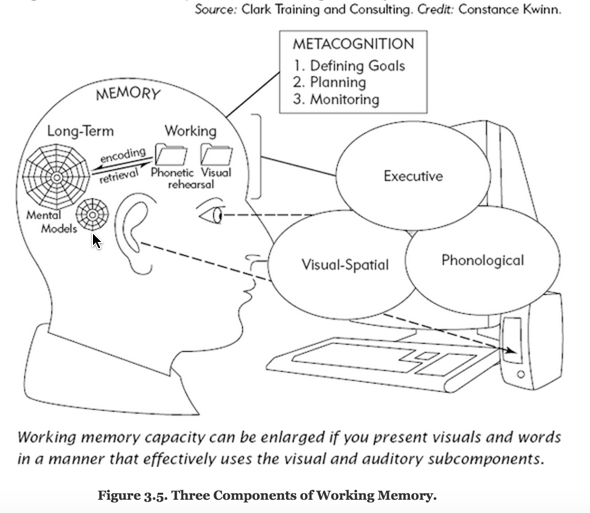
Relevant interactivity is one of the most crucial elements of effective eLearning modules. These are not necessarily simulations that are specifically “learning by doing”, although they could be. What is really at play here is having the learner focus their attention on content to enter it into their working memory. Then, time is given for the learner to process the information in multiple ways (we often refer to this as a reinforcement activity). However, in my mission statement I have chosen the word “exploration”. This increases the probability that the learner transfers the information, or encodes it, into mental models in their long-term memory. (Clark 68-69) If this is done effectively, namely with a relevant context, then knowledge transfer back to the working memory can be achieved when needed. (Clark 253-254)

howbrainswork
Image Courtesy: Ruth Clark and Chopeta Lyons, Graphics for Learning

Or as Clark writes it:

There is little value to mental models in long-term memory that cannot be retrieved back into working memory when needed on the job.

(Clark 254)

On an even more personal note, I first decided that I might be interested in instructional design because of a set of e-Learning modules I took while working at Lowe’s Home Improvement. The tagline at Lowe’s was “Never Stop Improving” and I could work with that,  these e-Learning modules were bland “data-dumps” with faulty multiple-choice quizzes.  I wanted to know how those modules were created, because I felt I could do better, and that is when I started on my interest in Instructional Design.

works cited

CAST (2018). Universal Design for Learning Guidelines version 2.2.
Retrieved from http://udlguidelines.cast.org

Clark, Ruth Colvin. Building Expertise: Cognitive Methods for Training and Performance Improvement. Pfeiffer, 2008.

Husmann, P. R. and O’Loughlin, V. D. (2018), Another nail in the coffin for learning styles? Disparities among undergraduate anatomy students’ study strategies, class performance, and reported VARK learning styles. American Association of Anatomists. . doi:10.1002/ase.1777

Animated Lesson Introductions

Photo Credit: “Marceline – Adventure Time” via Tofu Verde – flickr.com/

Let’s face it, cartoons are fun to watch and if we are really honest with ourselves we have learned a lot from them.

I am interested in improving my skill-set around creating video shorts that explain a complicated idea in a short, light and easy to consume cartoon. I have seen similar content done on Prezi but really, although I do like digital zooms I really feel like that sort of presentation is really just a PowerPoint with extra bells and whistles to distract participants from the content. Especially now that PowerPoint has introduced the “Morph” Transition. I know it is a popular platform but I have heard a wide range of mixed responses to the platform. Some have even said that it makes them feel sick. Besides, a formal presentation is what I am trying to move away from. As I said, I want to make a narrative cartoon.

I had done some work with Animoto and it is a wonderful online app that is fast and very easy to use. I had not seen many ways to do much more than an animated slideshow with the Animoto platform so it really does not speak to my need.

I found an app called Wevideo that looked at face value like a simple online video editor that you might compare to a souped-up version of the legacy Windows moviemaker that came standard on Pre-Windows 7 Operating Systems. When I have some raw video that I would like to edit I look forward to leveraging that platform, but again I want to make some cartoons.

So then I narrowed it down to two platforms that I felt might be able to create something that I am looking to do. Powtoon, Vyond and GoAnimate stood out as industry standards which aim to do exactly what I want. Start with some audio and quickly build out some cartoons around the story. I researched both and at face value, GoAnimate seemed like the higher-shelf product. It had very modularized backgrounds or sets I would even call them, gobs of props, and characters complete with emotions and animations. The item the sealed the deal was they have the voice to lip sync technology (which I later found is not part of the free trial) that makes the characters actually move their mouths in sync with the vocal audio (but you know, like cartoons do.)

Powtoon was attractive simply because it also looked very good. The animations looked very colorful and compelling. The backgrounds looked great if not as adjustable as the sets on GoAnimate or Vyond. The attribute that made me really long and hard at Powtoon was they have a permanent free option whereas the lowest level on GoAnimate (after a 15-day trial) was $50 a month. Not bad if you make cartoons for a living but too much if it is just something you do once in awhile.

So I have decided to try out both Powton, Vyond and GoAnimate. So far I have only created a short 1 min. video in GoAnimate and I absolutely love working with the platform. I had a beer and knew my way around before the beer was finished. Not bad… Not bad at all. An hour later I have a link to my final product. What did I learn? With the free trial, GoAnimate will place a watermark on the whole video, whereas friends at work have shared that PowToon just pops in a little icon on the bottom corner of the screen. The same is true with Vyond. Powtoon is the lowest pricepoint, and higher than that would be GoAnimate. In my opinion the most expensive platform, Vyond, is worth every penny. There are just so many more characters, set peices and automated animations. In addition set peices themselves are moveable.

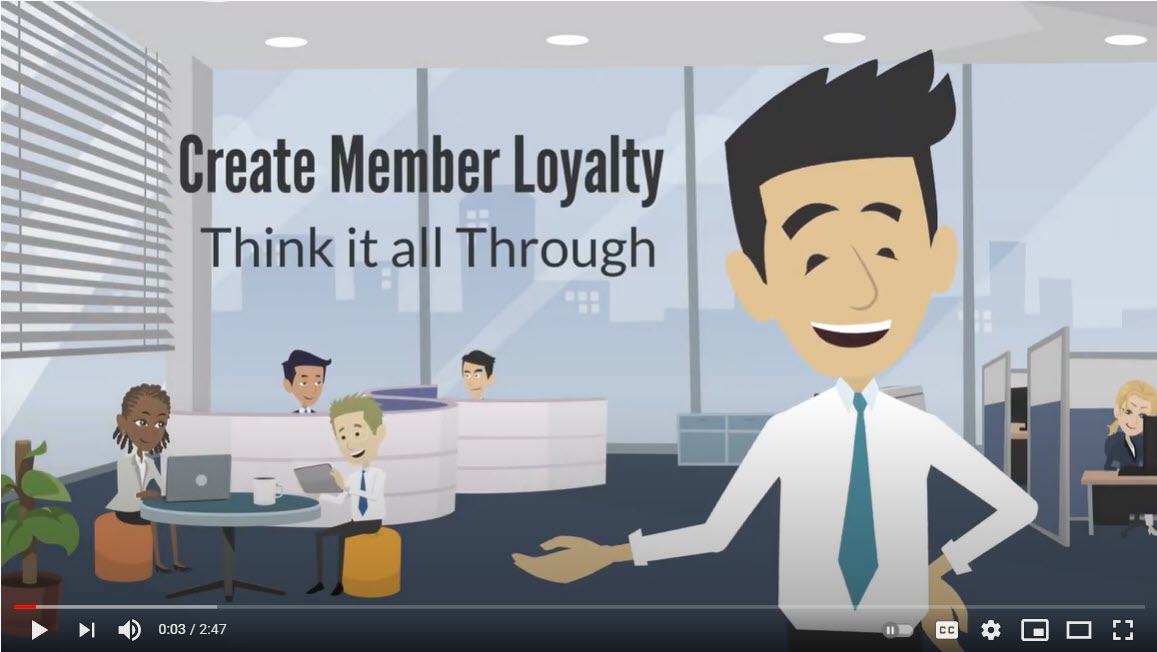
Here is an example of a cartoon I created on Vyond:

member loyalty

Learn from the Narrative

Title Image: https://upload.wikimedia.org/wikipedia/commons/

This blog post explores the idea of leveraging Podcasts to support the learning and instructional process. With the connectivity of the Internet age and the increase of social learning, Podcasts have become a very popular way for people to learn new ideas and gain new skill-sets.

In my personal life, I have enjoyed the narrative of podcasts like Radiolab, Serial and S-Town. Although these podcasts are true stories, that are gripping and enlightening, they do not necessarily build a definable talent or even marketable knowledge, or do they? These immensely popular podcasts do generate a deeper understanding of the human condition and I have enjoyed them immensely. If nothing else they increased my sense of empathy for other people who are not like I am. Did they teach me a new skill? Well, no, not really but does all learning need to give you a practical skill?

HEY! I work for The Man.

So, I am looking at this from the corporate perspective simply because I am currently employed as a corporate trainer, working for “the man”. From my perspective what is learned is defined by business needs and ways to increase the profit margin. When you introduce a topic, in the corporate training environment, you list the behavioral learning objectives using verbs that describe what learners will be able to “DO” (to better serve the business) at the end of training. I do not mean to cheapen the concept of what learning is, much the opposite in fact. So, with that in mind let me dream about pure learning for the sake of learning, say at a school…


Podcasts in Class?

In his article for The Atlantic, Michael Godsey, shares of his difficulty to get students to read but how he discovered the same students were activity engaged in discussing podcasts, such as Serial, outside of class. He even compares this difficulty to adult’s excuse that it is hard to find the time to sit down and read but Podcasts, on the other hand, present a learning modality with a different set of rules. So, he introduced a unit that leveraged the engaging power of the Podcast. Michael shares are feelings on the subject:

“While I felt guilty the students weren’t reading very much during this unit, their engagement with a relevant and timely story—their eagerness to ask questions, their intrinsic motivation to use critical thinking—seemed to make it worth it, at least temporarily. The students voluntarily studied maps, evaluated clues, argued with each other, and wrote twice as much in their journals as they previously had.”


Freakonomics Radio

freakenomics Radio - The hidden side of everything
The hidden side of everything


There are other Podcasts that I have enjoyed in my personal life that I feel have come closer to teaching me an actual skill. Freakonomics is a podcast that I have listened to the most. This show aims to debunk common misconceptions of the modern world through the discoveries of Economics. Branding themselves as “The hidden side of everything” they ask experts in niche areas of Economics to share what they have deduced from their data-sets. If nothing else this show has helped me think more critically and analytically. Stephen Dubner and Steven Levitt, or the Steves, got their start on the subject by co-authoring “the book and blog by the same name” and then decided to break into the Podcast space. I for one am certainly glad they did.


Steve_Levitt_presents_Freakonomics_at_Dell_World_2012
“The Steves”- (Dubner seated Levitt standing)          Image:https://commons.wikimedia.org.

This podcast (and Blog) work in with my Personal Learning Network because the content cuts through all of the emotional baggage and lies we tell ourselves. We are looking at data to locate the truth and it is less important how we feel. An instructional designer must use a needs analysis to find the truth of what is really needed by the learners. It is up to them to build the curriculum around those needs and involve actions that train to those needs, not use some activity they like which does not serve the higher purpose of what needs to be learned; or use the latest trick in Captivate or Storyline to make them look fresh and cutting edge. In addition, serving the needs of the learning is also up against resistance from business leaders who want to add insignificant granular details or destructive animations and sound effects to the training. A true ID will stand up for the truth. They will become an outsider and build a training that will actually improve the world. Not just add more noise.

Bigger Pockets

Another Podcast that I think does a fantastic job of training people in their everyday lives to build a valuable skill-set or knowledge base is The Bigger Pockets Podcast. The Bigger Pockets team actually started out by creating a social network around real estate investments which has grown to be one of the (if not the biggest) to date. Biggerpockets.com is a social media site of sorts where you can log in and network with other real estate professionals (and novices) from around the world to grow your real estate prowess. At one point the creators noticed that their plan had actually worked so they decided (the verdict is out on who decided to) start a Podcast. Now, over 200 podcasts later the show is a smash success.

Josh-and-Brandon-for-Podcast-Page
Brandon Turner (left) and Joshua Dorkin (right)

The reason the show works as a learning model is that it relates to the listener on a social level. Joshua Dorkin and Brandon Turner are not afraid to take cheap shots at each other and even throw in some amazing (as well as questionable) humor when they speak with their incredibly successful guests. This realness of the show leaves the listener feeling as though they have simply met up with the team at a coffee shop or bar somewhere and are listening in.

As studies have shown, this communicative storytelling narrative drastically increases knowledge retention. Research supporting the personalization principle shows that more knowledge is retained when it is presented in a conversational tone. (Moreno and Mayer 2000) Similar to Freakonomics the Bigger Pockets crew also invite the best of the best on to their shows, subject matter experts if you will, who have amassed millions of dollars through real estate and are proven experts on the subject. So, you know you are getting solid methods that have been tested in the real world. One of my favorite parts of the show is they ask every guest what their favorite real estate book (that they did not author) is. In this way, I have discovered (and read) numerous books on the subject that I otherwise might never have heard of.

At this point, the interview with Austin Fruechting is still one of my favorites. Check it out here.

https://www.biggerpockets.com/renewsblog/biggerpockets-podcast-239-achieving-financial-freedom-age-32-austin-fruechting/

The Bigger Pockets podcast is a large part of my Private Learning Network (PLN). I am a designer, a performer, a teacher, a trainer and I am an instructional designer with an emphasis in Learner Experience. The interest I have in these topics revolves around a love of learning and sharing what I have learned. However, when I have achieved a certain amount of capital it is real estate that I am ultimately interested in. I like buildings, I like houses and I am excited by the prospect of owning more of them… Ultimately, I would like to design learning content around real estate investing but I am simply not there yet.

So what are your thoughts? Have I convinced you to use Podcasts in your teaching or training efforts? Please leave your thoughts below.

playerfm.pngAnd if I have convinced you then check out this list of featured Learning Podcasts that were hand selected by our friends at Player.FM

work cited

Monero, R.& Mayer, R.E (2000b). Engaging students in active learning: The case for a personalized multimedia message. Journal of Educational Psychology, 93, 724-733.

Godsev, Michael (2016, March 17). The Value of Using Podcasts in Class- Ironically, they can encourage students to read more. Retrieved from URL https://www.theatlantic.com/education/archive/2016/03/the-benefits-of-podcasts-in-class/473925/


Social Networking

Title image: Social Network Analysis Visualization.
Courtesy of Wikimedia Commons

I shared my portfolio with my mother last week, who exited the full-time professional world back in the 80s, and all she could say was, “Oh, wow. Times have really changed.”;  and she was right. Times have changed more than we know in countless ways we will never know.

Take the job search for example; it will never be the same. Finding work has always been loosely related to who you know, but now it is easier to connect with people from all over the world with the click of a button. (In fact, many of the first steps into our next role starts with being discovered by an online search-bot, not a person at all.) But HOLD ON! wait just one hot minute Improvement Dave, this blog post is about being social, not about cold lonely robots that live online.

The dawn of the internet age has changed our world forever. As Marcia Conner reminds us in her interview on theelearningcoach: access to mobile devices is more prevalent than access to clean water. Let that sink in, the number of us that have smart phones is greater than the number of us that have access to water to drink. Her interview is amazing by the way. Check it out here:

marcia-conner-podcast2


Professional Network Groups

Professional Network Groups are an added layer to this ability to connect across large distances. Joining a group is a fantastic way to grow your circle of influence, learn about best practices in your industry and just meet some new people who share common interests with you. Although the Groups on Facebook do include a vast range of interests, for professional development and performance enhancement Linkdin.com is the place to go.

facebook

Personally I find that the groups I join on Facebook reflect my personal interests that I enjoy in my free time, and sure those interests do cross over into my professional life. Overall, there seems to be an unwritten perception that Facebook is more of a Social Network and Linked In is s Professional Social Network.


246x0w

Just by the nature of Linked In I have joined groups that directly relate to my career. Being a Learning and Development specialist I have found numerous groups that discuss best practices in training facilitation, Instructional Design and eLearning. Not to mention I have befriended and then followed people from those groups. It is their posts the enrich my feed with what is called social learning.

Social Learning

We are social creatures. There are many studies that reinforce the hypothesis that people learn more in a social environment. In her article on elearningindustry.com, Juliette Denny presents the 70-20-10 model. The research around this model shows that we learn 70% to 90% of what we know from work while on the job. It breaks down like this, while at the workplace learning is:

  • 70% ‘on the job’ that is by experience
  • 20% by watching others
  • 10% through formal training

What can we take away from this? Social Networking is not simply a way to meet a new friend or find your next gig. Social networking is an extremely effective way to learn; a proven modality to better yourself and increase your workplace performance.

So, the next time you find yourself beating yourself up for spending 10 minutes on Linked In reading content related to your industry, stop. You are doing yourself a favor. However, if you find yourself spending hours at a time watching cute cat videos, then you might want to take a look at your priorities in life.

Tigress_walking_1884~1886.gif


Image courtesy of Wikimedia Commons

works cited

Denny, Juliette (2017, November 22). Social Is Sexy: 11 Reasons Why You Need An Informal Learning Strategy. Retrieved from URL https://elearningindustry.com/informal-learning-strategy-11-reasons-need-social-sexy-70-20-10-model

Malamed, Connie (2016 ?). Social Learning Is A Way Of Life – Conversation with Marcia Conner. Retrieved from URL http://theelearningcoach.com/podcasts/29/?utm_source=linkedIn&utm_medium=social&utm_campaign=SocialWarfare


Social Bookmarking

  • Have you ever had a computer die on you and you lost all your sweet bookmarks?
  • Has your cell phone ever nearly crashed because you had 30 web browser tabs up that you were going to “check out when you find the time?”
  • Have you ever sat and gazed at the stars wishing there was a way to have a platform where you could save bookmarks that will follow you for the rest of your life?

Well welcome to 2018! Where have you been?! There is a thing for this and it’s called Social Bookmarking.

There are a number of options from Pintrest for the more visually inclined and symabloo for more of an app-like tile look.

Whenever you have a link you like just add it to your profile and there it will stay until the end of time, or the end of the internet, which ever comes first. Click below to see my personal attempts with these tools.

Pinterest

Apps-Pinterest-B-icon_125

I have had Pintrest for awhile and I will get on evry once in awhile and spend 2 to 3 hours playing around. Check out my profile here.

Symbaloo

press-kit-logo


Symbaloo is a beautiful grid of icons that link to pages you like or want to visit at a later time. There are many option to customize your tiles to look just the way you want. Check out my page of links on Learner Experience here.

Truly Free Web Design

Image Credit: Pixabay Manuchi. /

In this post I aim to explore web-based design platforms that offer truly free web development. The criteria is that the user can design a web page, and have it hosted indefinitely, for absolutely no payment. I am comparing two options that I have heard the most about (Weebly.com and Wix.com) to an option that I am already using (WordPress.com)

Weebly.com weebly

Offers a free easy-to-use cloud-based drag-and-drop web site builder. According to PC Magazine’s Lead Software Analyst, Michael Muchmore, the web-editor does not let you place things anywhere you like similar to Squarespace ($12) but unlike Wix (free). The templates are clean and contemporary and present many image-rich options. Not to mention you get a free domain name (free includes “weebly”) and a $100 credit to Google Ads. The web-based builder boasts custom fonts that can be typed right onto the page (as opposed to typing text into a side-bar) and an image editor. You will have a weebly.com subdomain but will enjoy 500MB of storage with SSL Security. Muchmore states that the main thing that sets Weebly apart is that you can receive the HTML code of what you have created in a zip file via email, that does not include all of the store front code but most free editors do not offer any HTML save. So not bad at all for $0.00.

If you jump up to the Pro level it only sets you back a mere $12.00 a month and adds a good deal of goodies. You can add a search bar that helps your users find content. Media will jump up to video backgrounds and HD grade video and audio. Not to mention you get a free domain name (that does not include “weebly”) and a $100.00 credit to Google Ads. The pro level does have options to sell with a checkout on Weebly.com. If you jump up to the business level ($25USD/mo) you get a storefront right on your domain. For complete pricing options visit the Weebly Pricing Page.


WIX.com 

wix

Offers a free easy-to-use cloud-based drag-and-drop web site builder that above all is free form. Wix has modern clean templates to start you off but you are not bound to them like you tend to be with the likes of Weebly and Squarspace. Wix is the free web developer / hosting program that truly gives to free reighn to create a unique online space. You are locked in to hosting it on their site but that’s a pretty fair trade off for having a more complete artistic freedom. Besides it is free, so it isn’t like you are locking into a paid service. Another nice attribute of Wix is that the features just seem to keep growing. The list of new features is well, just expansive! To get started with With Wix all you need is an email and the templates are much more diverse than the mere seven that Weebly offers.

The paid services that Wix offers are also very tempting. If you already own a domain name you can use that domain with your Wix content for only $5.00 per month. Bumping up to the VIP option includes some incredible offers, including: 20 GB of storage, shopping cart / storefront, a unique domain name and unlimited bandwidth. To check out all of the paid options check out the pricing chart here.


WordPress.com 

wordpressIf you haven’t noticed the phrase wordpress is in the URL of this page. That is to say I am using the free wordpress platform to generate this blog. For blogging WordPress is fantastic and top of the line. There is not much leeway on having a freeform drag-and-drop experience without knowing some HTML. You can even use CSS language (but that will bump you up to $8/month). However, if you are composing a Blog, that’s not really the point anyway. All I want for a Blog is an ability to select my font, chose a size, maybe select some text color and have some basic controls on how my images appear. So, far WordPress.org has done all that I have wanted all for the price of zero dollars. Now if I wanted something a bit more creative, say to show of my artwork, or advertise my business I might something a bit more flashy. So, it’s really all about what you are trying to do; and to share my thoughts on Instructional Design and Educational Technology I am more than happy with the extremely easy-to-use interface of WordPress. It is true Web 2.0 and I haven’t even had to think of things like FTP and code not working.

Now as you start paying for WordPress the optimization and customization really kicks in pretty quickly. It really is only the free option that limits you to a basic blogger experience. At only $4 a month you are already well above what most other sites offer for their basic paid plans (Wix is the lowest and it starts at $5.) Just $4 gets you your own domain name with no WordPress Advertisements, templates, email tech support not to mention a hefty 6 GB of storage. If we jump up to the the top plan, the “Business” plan, It’s only $25 and it is loaded with all you need from exclusive pro templates to Google Analytics. The only thing really missing is a shopping cart for eCommerce. Worpress’ answer to that is third party plug ins. Shopify is a big trusted name and accounts that allow ecommerce start as low as $9 a month. If you want the details of the wordpress paid options check them out here.

Perspectiveamazon

This blog is about designing instructional content…

…but just to put this all this business in perspective you can open up a storefront on Amazon that supports e-Commerce, as well as full logistical and Customer Service support, for roughly $35 a month. The win is that you have the name of Amazon backing up the legitimacy of your storefront. The loss is that you are not building your brand up you are building up Amazon’s name. So, if you want to sell on-line and building your brand is not important to you then Amazon.com might be a whole lot easier for the same.

Conclusion

All of these platforms have something to offer. If you want to design something and have a reasonable amount of creative control and be able to take the code with you then Weebly is a good fit for you. If you want a true drag and drop experience but don’t need a copy of the code then Wix would do you right. If you want a platform to simply, and quickly, share your thoughts and photos with the world the WordPress is for you.


Author

bluedavesmallDavid Kolmer is a Learning and Development Specialist who focuses on curriculum development and eLearning authoring.


Work Cited

Michael Muchmore (2017). Weebly Review
retrieved from: http://uk.pcmag.com/weebly/34504/review/weebly

Michael Muchmore (2017). Wix Review
retrieved from: http://uk.pcmag.com/wix/34506/review/wix


IoT Opportunities in Education

network-782707_1280_Credit-pixabay-com:p-782707:?no_redirect
Image Rights: Pixabay

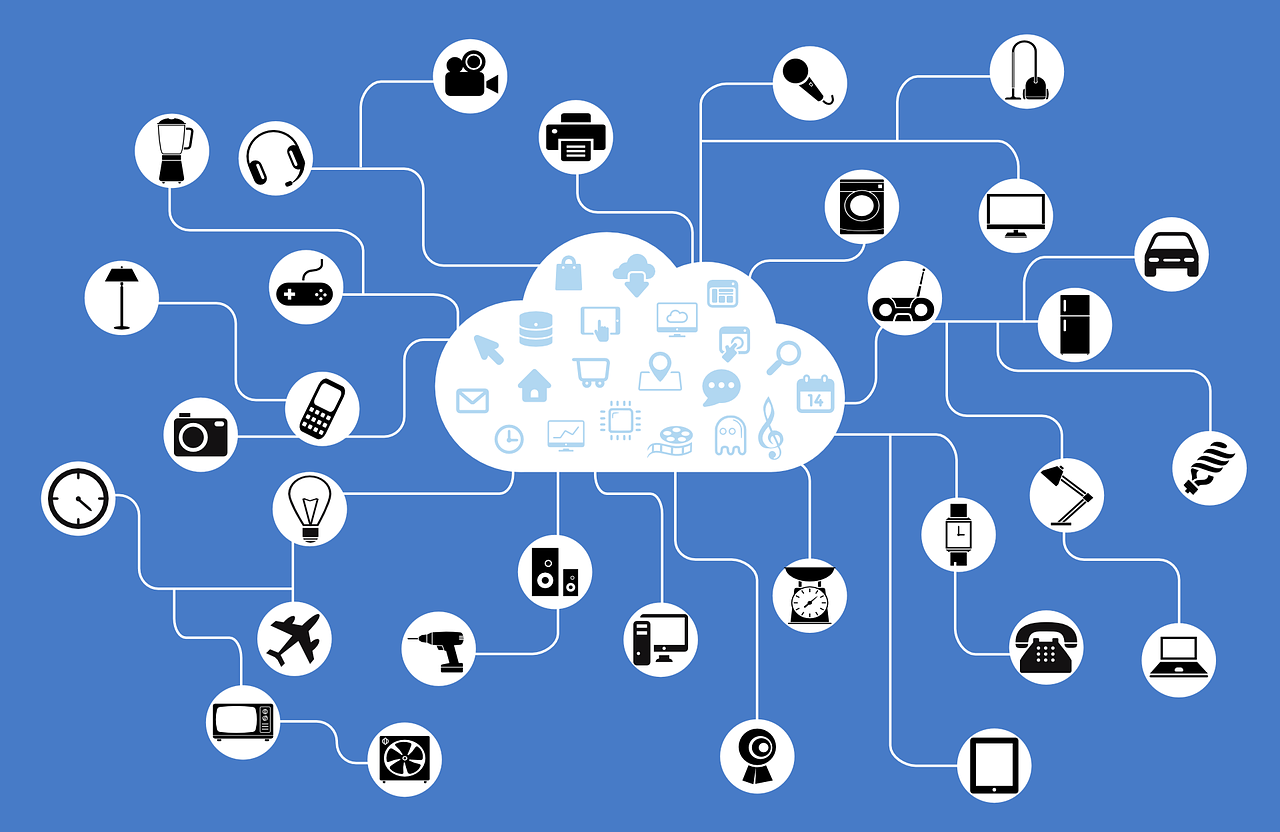
The Internet of Things

London_Film_and_Comic_Con_2013_-_Terminator_(9385843368).jpg
Image Rights: Wikimedia

When we think of the Internet of Things, that is objects in the real world being enhanced with smart-chips that enable them to send data over the internet, a few of us might recall Skynet from The Terminator franchise. If you have not had the pleasure, this is the story where a cloud-based internet system was leveraged by intelligent machines to overthrow the humans. Although this is a potential outcome of the IoT, it is not very likely. Well, not according to the AI FaceBook chatbots of 2017 anyway.

IoT, What Could Go Wrong?

Well, a lot could go wrong actually. In keeping with the skepticism of the opening statement of the blog post I would like to share a short clip from the recent Internet TV success Mr. Robot.

It is at this point in the story that the hackers involved appropriate the “Smart Home” and use it for a landing spot for a party. Although this scene is a bit dark, it does get us all onto the same page around what the Internet of Things encompasses.

It is important to remember that technology is not inherently good or evil in nature but it is the user that makes it so. This scene also reminds us of the potential safety and privacy risks inherent with implanting the internet into the objects around us.

It Can’t Be All Bad

The IoT revolution is not certainly all bad and there is no reason to assume that it will only end in disaster. In fact, in his his article for Business Insider, Andrew Meola makes a few very strong arguments on why the IoT is going to be extremely beneficial to the area of education. Depending on when and where you went to school the world of education might not be the first place you think of when you think of smart objects. However, as Meola points out in his article, there is a lot that the internet is already doing for the classroom. (Meola 2016)

Higher Education

digital-student-expectations.jpg
Image Rights: jisc

Meola writes that the majority of the forthwith “disruptions” in the education system are happening in the area of higher education. It is useful to highlight here that I received my undergraduate just after the start of P2P file sharing. What we now refer to as WEB 1.0 was in full swing and we had yet to see any disturbances of social media as we know it today in these final days of WEB 2.0.


At that time (2001) a majority of students went to the on-campus book store to purchase their books. If you were thrifty or taking a class you were not all that excited about you would simply purchase a used book. Amazon.com was certainly around but a majority of students didn’t think of purchasing books online. Sure it happened but not many of us had the idea of shopping online in the forefront of our minds. As I started my masters degree in 2016 I found a much different environment.

Online Learning

For starters the classes were completely online, I haven’t even had to go to campus. I have gone a few times because I am nostalgic and want to see the place that I am getting my degree from, but let’s be clear, I didn’t have to. The Schoology platform has really been all that I have needed to get my work done. It is a Learning Management System that also functions as a communication platform. If I have my laptop and WiFi I can get to work.

To Books or Not to Books?

In my first few Higher Ed. classes, in 2017, I have found that purchasing books is an optional task. Most of the courses have simply leveraged portions of digital resources owned by the school library. In my second class I did purchase books at the school bookstore. However, I shared this with a friend at work who happened to be a young millennial and he scoffed at my apparent lack of understanding. You know there are sites online that just let you rent the PDF, right?

As I have moved through this paradigm shift I have found that the library at my University has really embraced this brave new world. The biggest difference that I have benefitted from has not only been finding digital copies of needed texts online but in a number of cases the library had audio recordings of the readings I needed to complete. I downloaded them all in MP3 and loaded them onto my smartphone. I queued them all up and played them via bluetooth connectivity over my car’s audio system. In this way I had my homework read to me as I drove to work. Solid move Improvement Dave.

Research and Sources

Having legitimate support in your writings is now also much easier than it was back in the not-so-long-ago days before the internet. If you need data to support your ideas, it is now remarkably easy to locate a legitimate source. You simply search through a database with very a comprehensive search engine that allows many ways of searching, including multiple topics at once, to find the perfect article. (Example: EBSCOhost) Sourcing academic journals has never been easier.


It is going to be Great

So, although we have our share of television shows and movies that paint a picture of doom around connecting our things to the net, there really is plenty to be excited about. At this point there is no real threat of them becoming sentient beings that crave our destruction. This revolution has just started and we have really only scratched the surface. I can’t wait to see where this all takes us and what higher ground we find.

Author

bluedavesmallDavid Kolmer is a Learning and Development Specialist who focuses on curriculum development and eLearning authoring.


Work Cited

Meola, Andrew (2016). How IoT in Education is Changing the Way We Learn, 1.
Retrieved from: http://nordic.businessinsider.com/internet-of-things-education-2016-9